.png)
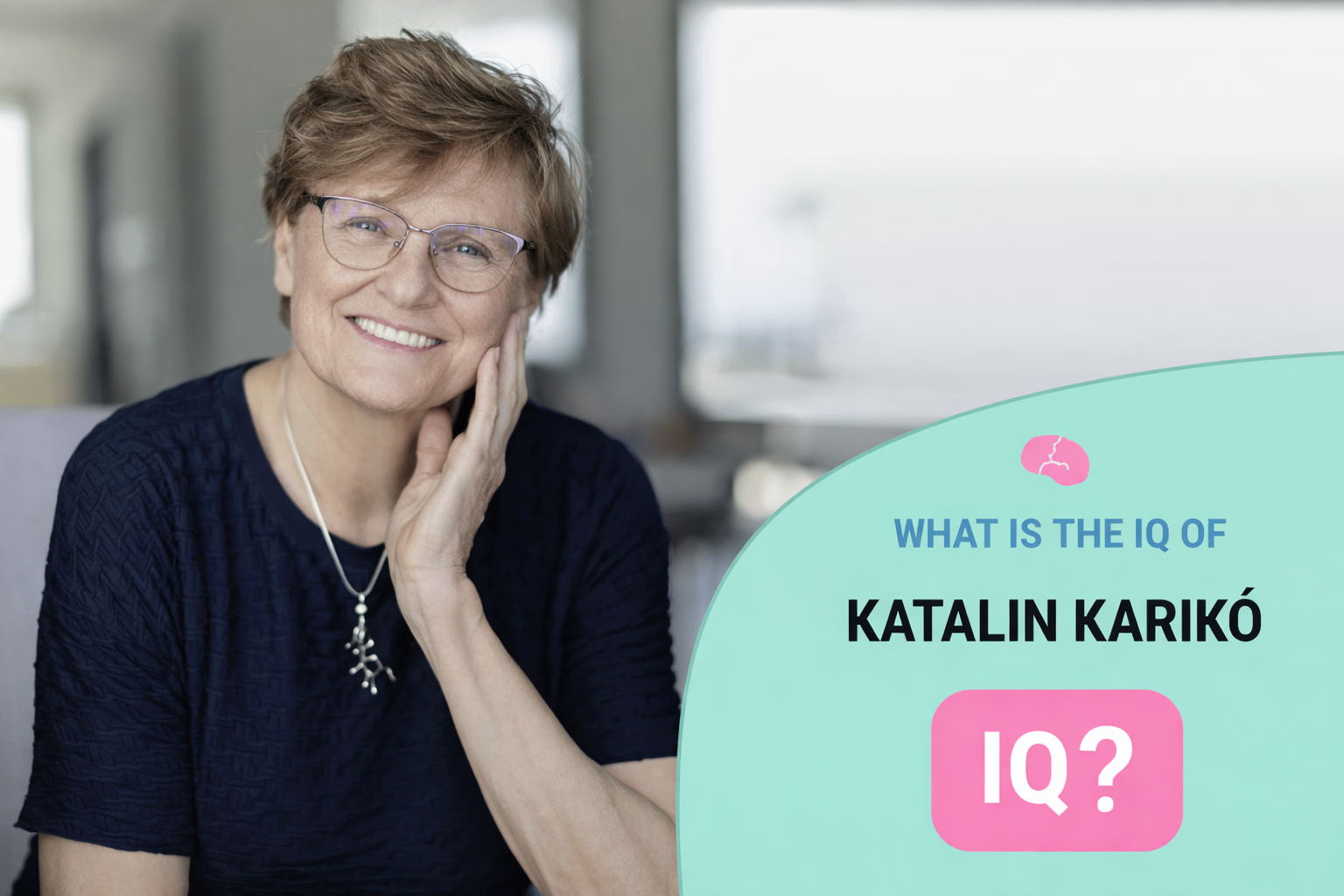


When Stockholm called to say she had won the Nobel Prize, Katalin Karikó did not respond like someone who had spent her life expecting applause. She thought it might be a prank. According to the Associated Press, she and Drew Weissman even waited to watch the official announcement before fully believing it. I have to say, that detail tells you a lot. Not about IQ directly, of course. But about the sort of scientist she is: more attached to data than drama, more used to being ignored than celebrated.
And that is why Karikó is such an interesting person to estimate. Not because she is famous now. Because for a very long time, she wasn’t. The real puzzle is this: how intelligent do you have to be to keep pursuing an idea for decades while grants vanish, promotions disappear, and much of your field more or less shrugs?
There is no public IQ score sitting around for us to inspect, so we have to do what biographers and mildly obsessive readers always do: build the case from the life. And in Karikó’s case, the evidence is unusually strong—elite scientific training, teenage academic excellence, major conceptual breakthroughs in biochemistry, and the sort of persistence that only becomes impressive after you understand what she was actually trying to solve. By the end, I think the number will feel less like a guess and more like the verdict in a very nerdy detective story.
A brilliant start, with very little luxury
Karikó was born in 1955 in Szolnok, Hungary, and grew up in Kisújszállás. Encyclopaedia Britannica notes that the family lived in a small home without running water, a refrigerator, or television. Her father was a butcher, her mother a bookkeeper. In other words: this was not one of those childhoods where genius arrives wrapped in expensive tutoring and shelves of imported science kits. She built herself in less forgiving conditions.
That matters for an IQ estimate. When someone rises from modest circumstances into the very top tier of world science, we have to give extra weight to raw cognitive ability and self-driven learning. Support helps everyone. But at some point the person is doing the lifting.
The early signs were there. The Academy of Achievement reports that she excelled in school and placed third in Hungary’s national biology competition as a teenager. Third in a national science competition in Hungary is not a cute little ribbon. Hungary has a famously demanding academic culture, especially in math and science. So already, long before mRNA entered the picture, we see a pattern: Karikó was not just hardworking. She was operating near the top of her age group in scientific reasoning.
And notice the combination. Not privilege plus polish. Curiosity plus performance. That combination often shows up in people with very high ability because they do not merely absorb lessons; they chase them down.
Szeged: where talent turned technical
Raw ability gets your attention. Advanced science demands something harsher: sustained abstract thinking. Karikó studied at the University of Szeged, earning a PhD in 1982, as the Nobel Foundation’s official biography confirms. This is where the case for her intelligence becomes more serious. A doctorate in biochemistry is not simply a badge for being diligent. It asks for the same core mental tools IQ tests only approximate in miniature: holding multiple variables in mind, reasoning about invisible structures, spotting patterns in messy data, and mentally simulating what happens when you alter one part of a system.
The Nobel Prize press release summarizes her later contribution as a discovery concerning nucleoside base modifications that enabled effective mRNA vaccines against COVID-19. If that sentence sounds technical, good. It should. The point is that Karikó’s eventual breakthrough came from understanding biological machinery at a very deep level. This was not flashy TED Talk intelligence. This was high-resolution molecular intelligence.
That distinction matters. Some smart people are verbally dazzling. Some are quick with numbers — those different cognitive strengths are exactly what models like the CHC model of intelligence try to map. Karikó’s profile looks like the elite scientist’s version: powerful analytical reasoning, the ability to keep multiple biological systems in mind at once, and enough conceptual precision to alter one part of the system without ruining the whole thing. That is rare, and it already pushes us well beyond merely “very bright.”
Then came America, and the part where academia embarrasses itself
After work in Hungary, Karikó moved to the United States in the 1980s and eventually joined the University of Pennsylvania. This stage of her life is where the story stops being a straightforward “bright student becomes great scientist” narrative and starts becoming much more revealing.
Because here is the awkward truth: institutions are not always good at spotting unusual minds in real time. Sometimes they are spectacularly bad at it.
STAT reported in 2021 that Karikó was demoted in 1995 after repeated grant rejections, despite earlier expectations that she might become a full professor. CNBC later summarized the same pattern even more bluntly: she was “demoted four times” at Penn. Read that again and try not to wince. The woman who would help enable mRNA vaccines was being pushed downward while trying to persuade the system that mRNA mattered.
You might think this weakens the intelligence case. Actually, I think it strengthens it—but only because of what happened next. She did not respond by abandoning the problem, chasing trendier topics, or dressing up mediocre work in fashionable language. She stayed with the hard question because she believed the logic underneath it was sound.
That tells us something important about her mind. High IQ, in the real world, often shows up as an ability to remain anchored to underlying logic even when social feedback is negative. According to STAT, Karikó later said she felt successful because she had “worked on something she believed was true.” That is not stubbornness alone. That is scientific confidence tethered to reasoning.
The breakthrough was not luck. It was a different way of seeing the problem
This is the heart of the case.
Messenger RNA had long seemed promising as a therapeutic tool, but there was a nasty problem: the body treated lab-made mRNA as an invader and triggered inflammation. Many researchers backed away. As the AP quoted Weissman saying, “Pretty much everybody gave up on it.” Karikó did not.
According to the Nobel Prize press release, Karikó and Weissman realized that dendritic cells were recognizing in vitro transcribed mRNA as foreign, and they hypothesized that missing chemical modifications were the reason. So they created different mRNA variants with altered bases. The result, in the Nobel committee’s words, was “striking”: the inflammatory response was almost abolished when the modifications were included. The committee called it a “paradigm change.”
That phrase is doing a lot of work. A paradigm change is not a minor tweak. It means the discovery reorganized how experts understood the system itself. If we are trying to estimate IQ, this is our strongest evidence. Karikó was not merely competent inside an existing framework. She helped change the framework.
And there is a lovely origin detail here too. According to AP and Penn Today, Karikó and Weissman began collaborating after a chance meeting in the late 1990s while photocopying research papers. A photocopier. I know. Science can look so glamorous from a distance. But that random hallway encounter led to one of the most consequential biomedical partnerships of this century. Karikó later summed it up simply: “We educated each other.” Smart people often do that—turn chance encounters into intellectual engines.
Persistence matters here because she was right
We should be careful here. Persistence by itself does not equal a high IQ. You can keep going for years and still be wrong. But when persistence is paired with technical originality, accurate long-term judgment, and eventual global vindication, it becomes evidence rather than background decoration.
Scientific American described Karikó and Weissman as having faced “nonstop technical hurdles for 25 years.” Very few people can stay cognitively engaged with a difficult problem for that long after the field has mostly moved on. Fewer still can do it correctly.
Her own writing makes this even clearer. In her 2023 memoir excerpt in Time, Karikó wrote that what mattered was whether “the science was good” and whether “the data supported” the approach, not whether someone had an Ivy League pedigree or was good at schmoozing. That is a revealing line. It shows a strongly evidence-centered cognitive style, the kind that tends to travel with high scientific intelligence. She was playing a longer game than the prestige economy around her.
She also criticized the usual academic scorecards—citations, publication counts, grant structures—as poor measures of real scientific value. Frankly, she had earned the right to say it. Her 2005 paper got little notice at first, even though it later became foundational. Sometimes the field is slow. Sometimes the field is wearing a blindfold and congratulating itself on its vision.
Then COVID arrived, and the whole world met the idea she had protected for decades
In 2020, the practical power of mRNA technology became impossible to ignore. Karikó, then working at BioNTech, had the surreal experience of seeing a line of research that had been doubted for decades become central to a global emergency response.
In her Time essay, she recalled that when the vaccine efficacy result came in, she was calm: “I felt I already knew.” The number was 95% efficacy against the circulating strain. That confidence is interesting. Not arrogance—something colder and more impressive. It suggests a scientist who understood the mechanism so deeply that the data arrived as confirmation of a model already built in her head.
Then she celebrated by eating an enormous box of Goobers. Honestly, perfect. You spend decades helping solve one of modern medicine’s hardest delivery problems, and your victory feast is movie-theater candy. That sort of detail makes her easier to trust. It suggests a person whose ego never fully bought the publicity machine.
By 2023, the official recognition arrived. The Nobel Assembly awarded Karikó and Weissman the prize “for their discoveries concerning nucleoside base modifications that enabled the development of effective mRNA vaccines against COVID-19.” Penn’s leadership called them “brilliant researchers” whose work “changed the world.” Ceremonial language, yes—but also language that, for once, undersells nothing. I genuinely think modern medicine will be talking about her for a very long time.
So where does that place her?
Once you line up the evidence, the pattern is hard to miss. The teenager who placed near the top of Hungary in biology became the scientist who could spot a hidden flaw in therapeutic mRNA and keep working the problem while institutions kept fumbling the evaluation. That is one continuous story, not two separate ones.
We have early academic distinction, elite technical training, a paradigm-shifting scientific insight, successful reasoning across several difficult fields, and decades of correct persistence under rejection. We also have something harder to measure but impossible to miss: unusual emotional steadiness. According to CNBC, her advice after repeated demotions was simple: “you have to focus on what’s next.” That is executive control. Not the whole story, but part of it.
If we put all of this together, Katalin Karikó does not look merely “very smart.” She looks exceptionally gifted—one of those rare scientists whose intelligence is visible not just in credentials, but in the structure of their decisions over time.
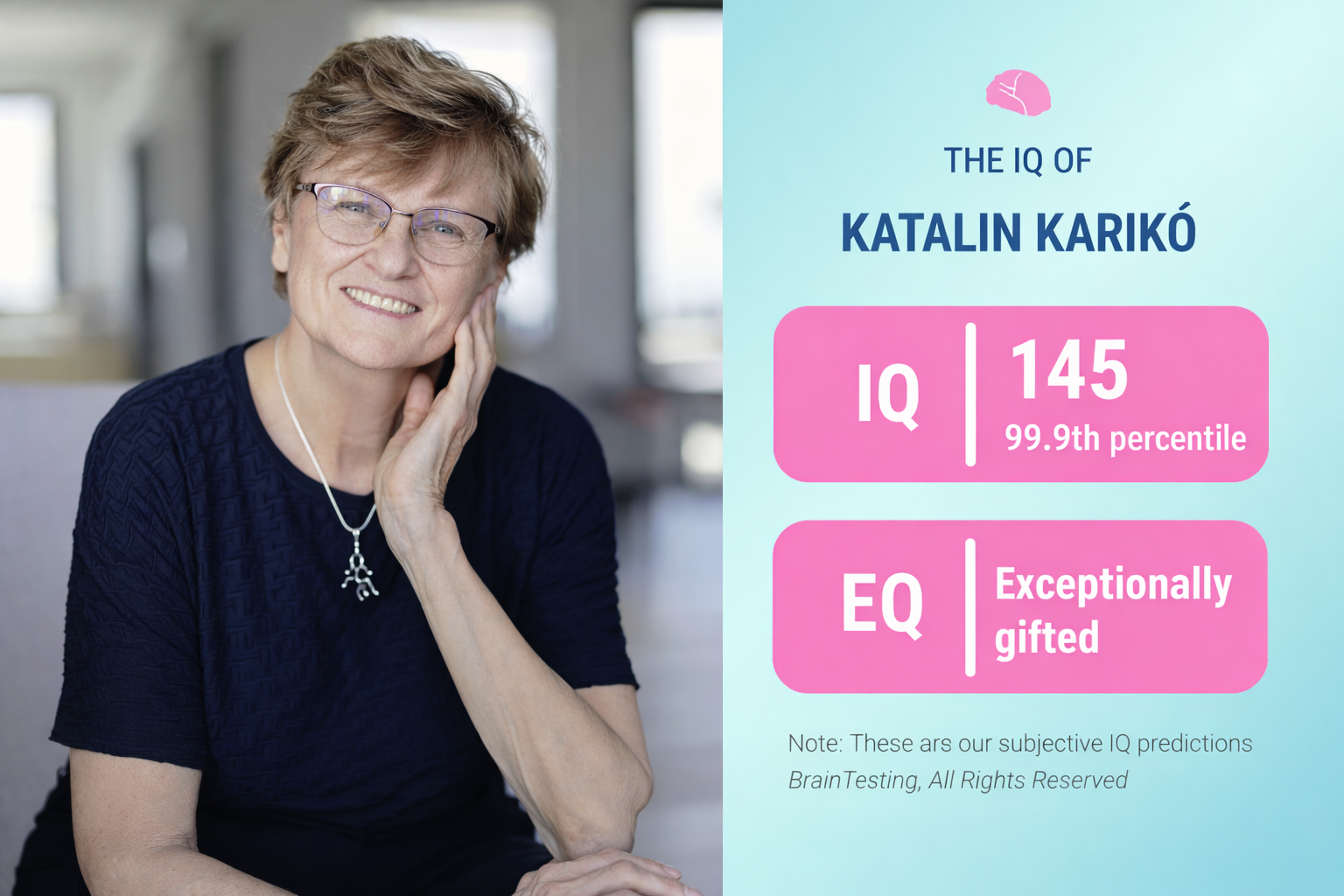
Our estimate is that Katalin Karikó’s IQ would likely be around 145.
That corresponds roughly to the 99.9th percentile, placing her in the category of Exceptionally gifted. Could it be a bit lower or higher? Of course. IQ estimates from biography are never exact. But 145 fits the evidence well: high enough to reflect truly rare analytical ability, not so cartoonishly high that we stop taking the exercise seriously.
And if you want the simplest reason for that estimate, here it is: lots of bright scientists can work inside a field. Far fewer can see the right answer when the field cannot, keep building it for 25 years, and then watch it save lives on a planetary scale. That is not ordinary intelligence. That is elite, world-changing intelligence — the same tier we explored when we estimated Stephen Hawking's IQ.



.png)