.png)
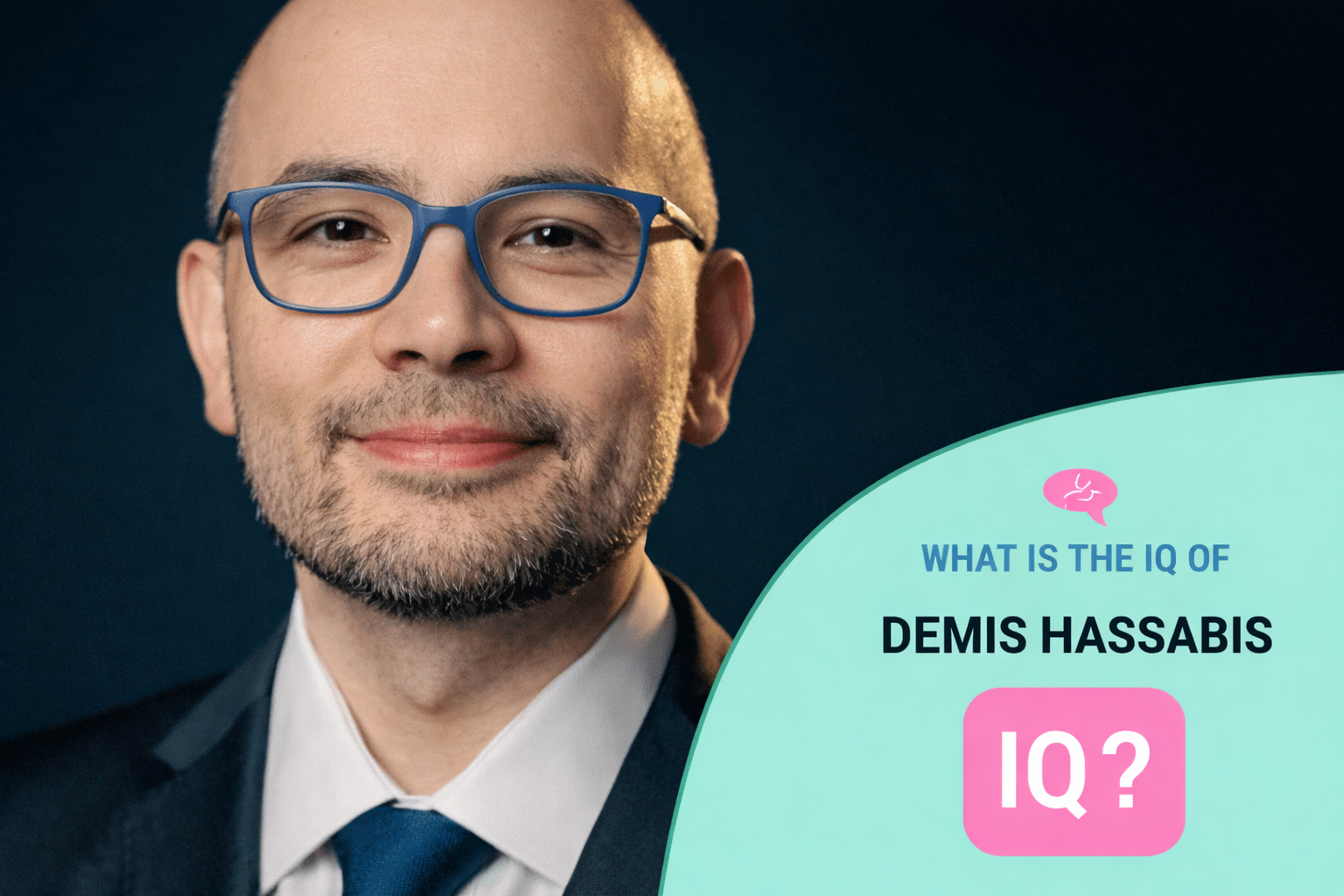


Demis Hassabis is one of those people who make normal ambition look like a charming hobby. Child chess star, teenage game designer, Cambridge computer scientist, neuroscientist, DeepMind founder, Nobel Prize winner—at some point you stop asking “is he smart?” and start asking the more dangerous question: how smart?
And no, there is no verified public IQ score for Hassabis. No secret lab report, no old school record, no “my IQ is X” boast on a podcast. So we have to infer. That is less precise, yes, but also more interesting. IQ is supposed to capture reasoning ability; a life like Hassabis’s gives us plenty of reasoning to inspect.
By the end of this, we will make a numerical prediction. But to make it feel earned, we need to build the case properly—from the four-year-old learning chess to the man helping crack one of biology’s hardest problems.
When a four-year-old starts beating the adults, you pay attention
According to his 2024 interview with NobelPrize.org, Hassabis learned chess at age four and took it “very seriously” very quickly. Axios reported the same basic story and added the delightful little detail that he surpassed his father and uncle within a couple of weeks. Within a couple of weeks. Some children learn how the knight moves; this one seems to have treated family game night like an optimization exercise.
That matters because chess is basically organized thinking under pressure. You scan patterns, hold possible moves in mind, predict consequences, and avoid fooling yourself. Do that at an elite level as a child, and people should probably stop calling you “bright” and start hiding the board.
The evidence piles up fast. The Guardian reported that by 13, Hassabis had reached chess master level and was the second-highest-rated under-14 player in the world, behind only Judit Polgár. Billy Perrigo’s 2023 TIME profile similarly noted that by 12 he was the second-best chess player in the world for his age. Different source, same picture: this was not “bright kid wins school tournament.” This was international-level precocity.
Already, we can say something important. Hassabis was not merely verbal-smart or book-smart. His early gifts look intensely fluid: abstract, strategic, pattern-heavy, fast. In IQ terms, that usually points to an extremely high ceiling.
Then the prodigy did something annoying: he kept proving it in other domains
Lots of smart children peak early in one niche. Hassabis did not. He accelerated through school, and The Guardian reported that he completed his A-levels two years early, at 16. That tells us his ability generalized beyond chess. Different task demands, different environment, same result: ahead of schedule.
And then comes one of my favorite details in the whole story. At 17, he co-designed and programmed Theme Park, the simulation game that became a major hit. In his Nobel interview, Hassabis said that writing Theme Park convinced him AI was what he wanted to spend his whole career on. That sentence is revealing. Most teenagers are busy planning the weekend; Hassabis was using commercial game design as a test bed for lifelong theories about intelligence. Extremely normal behavior. Very relatable.
The feat itself matters. Building a successful simulation game at that age is not just a technical trick. It requires systems thinking, user psychology, balancing variables, and translating abstract rules into something that actually works. Peter Molyneux, his mentor, told TIME that even as a teenager Hassabis had “the sparkle of intelligence,” and remembered their conversations as extraordinarily stimulating. Older experts do not usually talk that way about teenagers unless something genuinely unusual is happening.
So by late adolescence, the evidence is already broad: elite strategic play, accelerated academics, professional-level programming, and creative systems design. If we were only judging from the first 18 years, we would already be hovering in the highly gifted range. But Hassabis was not done warming up.
Cambridge was the first big stress test
Prodigy stories become more convincing when the person enters an elite institution and does not merely survive, but dominates. Hassabis studied computer science at Cambridge and, as The Guardian reported, earned a double first-class degree in 1997. That matters a lot.
Why? Because early talent can sometimes be flattered by unusual circumstances. Cambridge is the opposite of flattering. It takes very bright people, compresses them together, and politely asks which of them can still think clearly under pressure. A double first there strongly suggests that the childhood brilliance was not hype, parental mythology, or one lucky skill set. It held up among other elites.
And more than that, it tells us something about cognitive stamina. High-IQ people can impress in bursts; the rarer feat is sustaining top-level analytical performance over years in a brutally selective environment. Cambridge was not just a badge on a résumé. It was evidence that Hassabis’s mind traveled well.
This is also where the case gets more interesting. A very high IQ can show up as speed. An exceptional one often shows up as transfer—the ability to carry strengths across domains. Hassabis had already moved from chess to game design. Cambridge confirmed he could also operate at the top in a formal analytical setting.
Most people would stop there. Hassabis swerved into neuroscience
Here is the part that pushes the estimate upward for me. After succeeding in games and computer science, Hassabis did not simply stay in the lane where he was already winning. He pivoted into cognitive neuroscience at University College London, eventually completing a PhD.
According to a 2009 interview with The Naked Scientists, he explained that games had always been secondary to his deeper interest in artificial intelligence and understanding how the mind achieves goals. Steven Levy’s 2015 WIRED profile adds an important layer: Hassabis said he had been thinking about building his AI company since the mid-2000s, but believed he needed “a whole new set of ideas,” so he chose neuroscience to get them.
That is not just intelligence. That is strategic intelligence. Meta-intelligence, if you like. He was not wandering between fields because he lacked focus. He was building a toolkit on purpose. Frankly, this is the sort of career planning that makes the rest of us feel like we were improvising with crayons.
The Guardian noted that his neuroscience work on memory and imagination helped produce research recognized by Science as one of the top breakthroughs of 2007. Again, notice the pattern. He enters a new field and contributes at a level that gets the scientific world’s attention. We are no longer dealing with someone who is merely a fast learner. We are dealing with someone who can absorb the core logic of a field and do original work inside it.
That kind of transfer is a giant clue in any IQ estimate. Plenty of brilliant specialists exist. Much rarer is the person who can climb several steep mountains and then use the view from one to redesign the next.
DeepMind: the case stops being academic and starts becoming historic
By the time Hassabis co-founded DeepMind in 2010, the through-line of his life was visible. In the Nobel interview, he said the reason he spent his whole career on AI was that he believed it could become “the ultimate tool to help with science.” In Perrigo’s 2023 TIME profile, DeepMind’s headquarters is described as an “ode to intelligence,” which is either wonderfully ambitious or the most Demis Hassabis thing imaginable.
The key point for us is not branding. It is coherence. According to WIRED, Hassabis himself said that his whole career, including games, had been leading up to the AI company. That fits everything we have seen so far: chess trained strategic search, games trained simulation and human psychology, neuroscience trained him to think about memory and learning, and DeepMind became the synthesis machine.
This matters for an IQ estimate because world-class intelligence is rarely just raw speed. At the highest levels, it starts to look like architecture: a person sees how ideas that seem separate to everyone else actually lock together. Hassabis seems to have been building that architecture since childhood.
There is also drive. In his Nobel interview, he said he has always been “in a bit of a hurry” and had “unbelievable drive” for as long as he could remember. Drive is not IQ, of course. But when very high reasoning ability and absurd drive show up in the same person, outcomes tend to get dramatic — a pattern that also runs through our analysis of Bill Gates’s IQ, another tech founder whose engine refused to switch off.
AlphaFold changed the scale of the argument
You can be spectacularly intelligent and still never do something Nobel-level. Science is messy, history is unfair, and timing matters. But once AlphaFold enters the story, the case for an extreme IQ estimate becomes hard to avoid.
According to the Nobel Prize facts page, Hassabis and John Jumper were recognized for creating AlphaFold2, the AI system that predicts the structure of virtually all known proteins from amino-acid sequences. Protein folding had been a major scientific challenge for decades. This was not an app feature. This was a deep problem at the foundation of biology.
And here is the crucial backward reference: remember the child who learned to think several moves ahead on a chessboard? Remember the teenager building simulated worlds in games? Remember the researcher who deliberately studied the brain to get ideas for AI? AlphaFold looks like the convergence of all of it. Strategic search, abstraction, scientific reasoning, long-term planning, cross-domain synthesis—it all cashes out here.
Perrigo’s 2025 TIME profile quotes Hassabis saying, “I identify myself as a scientist first and foremost,” and that the reason he has done everything in his life is “in the pursuit of knowledge.” That does not raise IQ by itself, obviously. But it does explain why his intelligence has been spent so efficiently. Some very bright people scatter their gifts. Hassabis has concentrated his.
So what is Demis Hassabis’s likely IQ?
Now the hard part: a number. Not a myth, not a vague “genius,” an actual estimate.
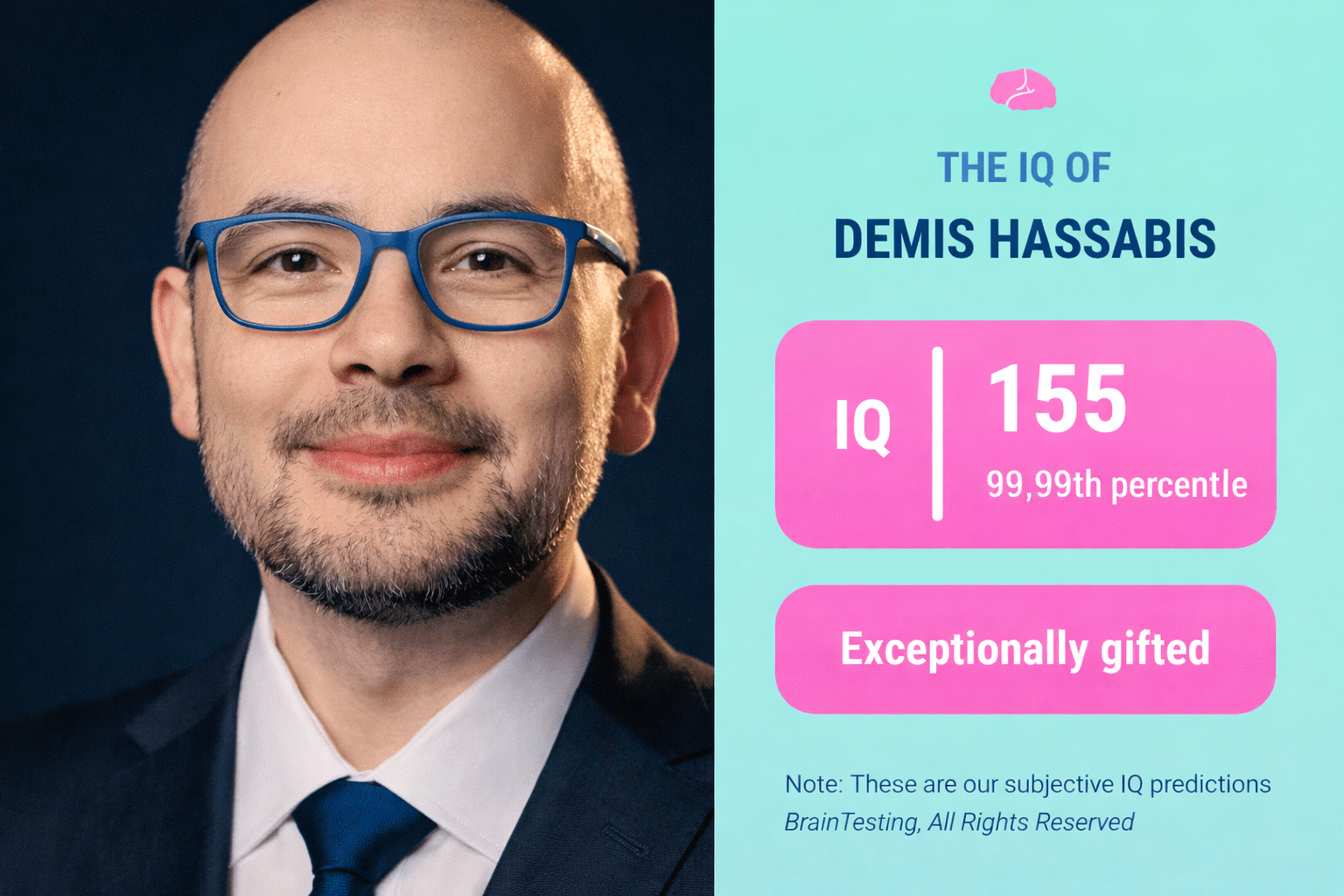
Based on the available evidence, we predict Demis Hassabis’s IQ is around 155.
That would place him roughly in the 99.99th percentile, in the category often described as exceptionally gifted or profoundly gifted, depending on the classification system.
Why 155 and not, say, 140? Because 140 is extraordinarily high, but Hassabis’s profile seems stronger than “merely” top-0.4% intelligence. Child chess mastery at global level, accelerated schooling, elite academic success, professional programming achievement in adolescence, major accomplishments in both neuroscience and AI, and finally a Nobel-recognized scientific breakthrough—that stack is rare even among brilliant people. For comparison, our estimate puts him just above where we landed on Stephen Hawking, another scientist whose biography pointed firmly to the extreme tail.
Why not 175? Because we should keep our feet on the ground. IQ estimates based on biography are always approximate, and internet culture loves turning every famous scientist into a comic-book superbrain. Real intelligence is lumpy. It comes with strengths, habits, opportunity, mentors, and an alarming willingness to spend decades on hard problems.
Still, if you asked me whether Hassabis belongs in the tiny slice of humanity where raw reasoning power, strategic imagination, and interdisciplinary synthesis all meet, I would say yes without much hesitation. His life keeps giving us the same answer in different accents.
So no, we do not know Demis Hassabis’s actual IQ. But if intelligence is the ability to learn fast, transfer across domains, plan far ahead, and solve problems that make other brilliant people sweat, then his biography points to a mind operating at a very rare level indeed—a mind that seems to have been playing several moves ahead for almost his entire life.



.png)