.png)
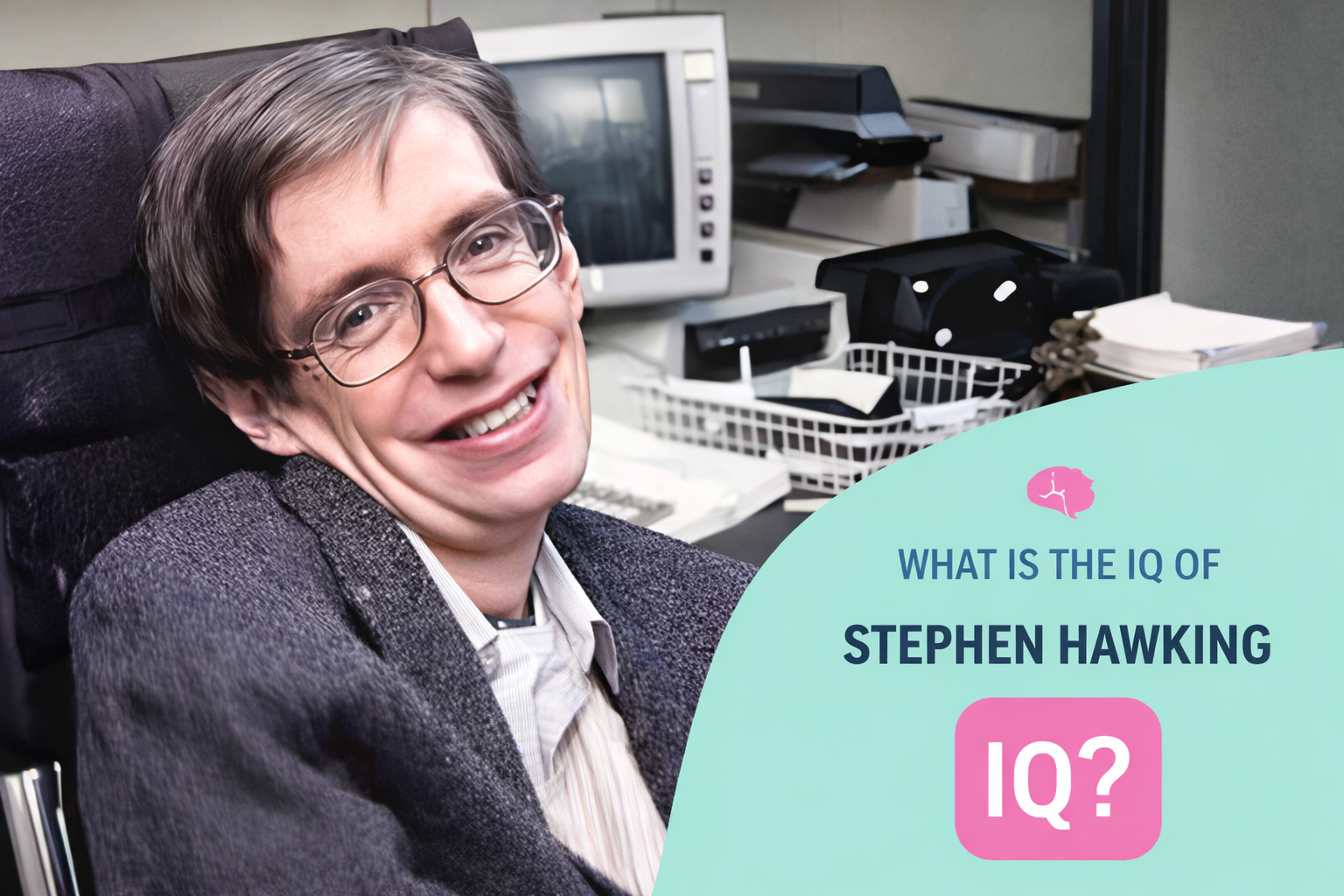


The internet loves neat numbers. Stephen Hawking’s mind, unfortunately for the internet, was not neat.
Type his name and “IQ” into a search bar and you will quickly run into the same suspiciously tidy claim: 160. Very dramatic. Very clickable. Also, almost certainly unsupported. A 2004 Washington Post piece recalled the famous Larry King exchange in which Hawking was asked his IQ and replied, “I have no idea.” Dennis Overbye’s 2018 obituary in The New York Times returned to the same point: Hawking himself did not seem interested in turning his intellect into a scoreboard.
That does not mean the question is silly. It just means we have to answer it like adults, not like listicle merchants with a keyboard and a dream. So instead of pretending there is a secret test result in a drawer at Cambridge, we need to do something more interesting: build a case from his life.
And Hawking gives us a fascinating case. He was not the classic child prodigy in the movie version of genius. He did not blaze through school collecting perfect marks and terrifying teachers by age nine. In fact, one of the best starting points is almost the opposite.
He did not look like a future genius at first glance
Michael Church wrote in The Independent that “once upon a time, Stephen Hawking was just another schoolboy.” That line matters because it punctures a myth we love: that real genius always arrives wearing a giant neon sign. Hawking did not.
At St Albans School, he was placed in the top academic stream, which already tells us he had strong ability. But Church also described him as the sort of student who could seem detached, slouching at the back, gazing out the window, and not always impressing teachers in the conventional way. One teacher reportedly even called him “not very bright” after he failed to answer a question. Imagine finding out later that this was your take on Stephen Hawking. I would move countries.
What do we do with evidence like that? We should not ignore it. And we also should not overread it. A student who appears average in class can still be operating far above the class if he is bored, internally preoccupied, or simply uninterested in performing intelligence on command. Hawking’s later life suggests exactly that. According to Church, classmates remembered him reading widely outside school and accumulating knowledge informally. That pattern matters because high-IQ people often show not just ability, but self-directed curiosity. They wander off the syllabus and, inconveniently for everyone trying to grade them, sometimes do better there than inside it.
So the school years do not scream “certified prodigy.” But they do show something subtler and, in some ways, more convincing: a mind that was selective, internally driven, and a little allergic to routine display.
Oxford confirmed the ability, even if Hawking barely played the game
If school left the case half-open, Oxford pushed it forward. Hawking won a place at University College, Oxford, to study physics, and getting there already meant he was operating at a very high level. But the more revealing part is what he did once he arrived.
According to Hawking’s own memoir, My Brief History, he “lacked motivation and did minimal work.” That sentence is gold for anyone trying to understand his mind. It tells us two things at once. First, he was not a grinding, hyper-disciplined academic machine. Second, he was cognitively efficient enough to survive one of the most demanding academic environments in Britain without behaving like a monk of revision.
This is where the IQ conversation gets interesting. IQ, imperfect as it is, tends to correlate pretty well with abstract reasoning, pattern detection, and rapid learning. Hawking’s Oxford record suggests exactly those strengths. Kitty Ferguson, in Stephen Hawking: His Life and Work, stresses that he was never a uniformly polished student. His grades across subjects were uneven, and he often trusted intuition over dutiful preparation. That sounds risky because it was risky. But it also points to something we see in unusually gifted thinkers: they can look oddly unimpressive right up until the moment they do something no ordinary student could do.
To be clear, this does not mean every low-effort student is secretly Stephen Hawking. Some people are bored geniuses; many are just bored. But in Hawking’s case, the combination of elite admission, low visible effort, and later world-class output suggests he was operating far above ordinary academic ability.
Then life became brutally serious, and his mind became even more focused
There is a point in Hawking’s story where the article stops being merely about talent and starts becoming about cognitive force under pressure. In his early twenties, after beginning graduate work at Cambridge, he was diagnosed with ALS, the motor neuron disease that would progressively paralyze him.
That kind of diagnosis could shatter almost anyone’s plans. For a time, it nearly shattered his. But according to My Brief History, the disease progressed more slowly than expected, and he was able to continue his research and even revise his thesis. That line is easy to read quickly. Don’t. He was dealing with a devastating neurological illness and still doing high-level theoretical physics. That is not just intelligence. That is concentration, resilience, and the ability to keep an abstract problem alive in the mind while life is doing its worst around you.
Jane Hawking’s memoirs describe him as playful, mischievous, and intensely drawn to big questions rather than mundane tasks. That fit suddenly mattered even more. Theoretical physics was one of the few human pursuits where a body in decline did not have to mean a mind in retreat. In a strange and awful way, Hawking’s field was suited to the kind of thinker he already was: highly conceptual, visually imaginative, and more interested in first principles than in physical apparatus.
This is also where we start seeing why a normal IQ test would only capture part of him. Standard tests are snapshots. Hawking’s life shows sustained abstract reasoning under extreme constraint. That is a different beast (and a much tougher one).
The real evidence is in the breakthroughs
By this point, we already know Hawking was very bright. But “very bright” is a crowded category. The question is whether his work pushes him into the rare air where words like genius stop sounding embarrassing and start sounding accurate.
Yes. It does.
Take Hawking radiation. In 1974, he proposed that black holes are not completely black but emit radiation because of quantum effects near the event horizon. If that sounds like the sort of sentence people pretend to understand at dinner parties, fair enough. Here is the important part: Hawking connected ideas from general relativity, quantum theory, and thermodynamics in a way that changed the field. John Preskill later wrote in Caltech Magazine that Hawking transformed black holes from simple classical objects into something deeply tied to quantum information. That is not just hard work. That is conceptual penetration.
Ferguson’s biography tracks the speed of his rise: groundbreaking work in his twenties, then Lucasian Professor of Mathematics at Cambridge by 32, in the same chair once held by Newton. You do not get there through media hype or one lucky insight. You get there by repeatedly seeing structures in reality that other brilliant people have missed.
And notice the specific kind of intelligence this suggests. Not trivia intelligence. Not test-coaching intelligence. Not “can solve 80 algebra drills before lunch” intelligence. Hawking’s strength seems to have been the ability to hold incompatible ideas in his head, worry at the contradiction, and eventually find a deeper framework that made them fit. That is the sort of reasoning IQ tests try to approximate with abstract puzzles, only in his case the puzzle was the universe. Slight difference.
How Hawking seems to have thought
This part matters because achievements alone can mislead us. A brilliant career can reflect not only intelligence, but opportunity, timing, mentors, and relentless work. Hawking had some of all that. But colleagues consistently point to something distinctive about how his mind operated.
In Black Holes and Time Warps, Kip Thorne described Hawking as a thinker who worked geometrically and visually, almost as if he could move through spacetime in his head and only later translate that intuition into mathematics. That is a huge clue. Visual-spatial reasoning is part of intelligence, but in theoretical physics it can become a superpower.
Brian Greene later summed up the problem nicely in Scientific American: Hawking’s genius was “not something one could distill into a number”; it was the audacity and coherence of his ideas. I like that because it avoids the fake precision trap while still acknowledging the obvious. Hawking was not merely smart in a broad, polite sense. He had rare conceptual originality.
There is another useful corrective here. According to a 2019 New Scientist report by Marina Antonini, postmortem examination of Hawking’s brain found no magical “genius anatomy.” The overall structure was normal. In other words, there was no secret alien hardware hiding in there. His brilliance appears to have lived in patterns of thought, not in cartoonishly oversized brain parts. (Science is rude like that. It keeps ruining our myths.)
That matters for the IQ estimate too. We are not looking for evidence of mystical superhumanity. We are looking for signs of extraordinary reasoning, learning, synthesis, and creativity. Hawking gives us those signs in bulk.
He was not only a theorist. He was a translator of complexity
One of the easiest mistakes in articles like this is to treat popular writing as fluff compared with “real” scientific work. Not here. Writing A Brief History of Time was itself evidence of serious intellectual range.
Think about what that book required. Hawking had to explain time, black holes, the Big Bang, and the fate of the universe to non-specialists without flattening the ideas into mush. That takes more than knowledge. It requires mental modeling, verbal precision, audience awareness, and the confidence to reorganize difficult material into clear layers. In IQ terms, this points to unusually strong verbal intelligence and cognitive flexibility: he could understand an idea at expert depth, then rebuild it for ordinary readers without breaking it.
Lots of brilliant researchers cannot do this at all. Hawking could. Overbye’s obituary also reminded readers that Hawking’s public persona included quick wit and comic timing, from interviews to television cameos. That may sound minor, but it is not. Humor often rides on fast pattern recognition and surprise. Hawking was not a machine dispensing equations. He was mentally agile enough to move between frontier physics and public communication without losing his personality.
And that returns us to the beginning. When he said, “I have no idea,” in response to the IQ question, I doubt he meant he had literally never encountered the concept. He was puncturing the premise. Fair enough. Still, his life leaves enough evidence for an educated estimate.
Our IQ estimate for Stephen Hawking
So where does all this leave us?
Not at 160 as a matter of fact. There is no credible evidence for that number, and repeating it as if it were verified is just numerology with better branding.
But it also does not leave us shrugging and saying, “Who knows?” We know plenty. We know Hawking reached Oxford and Cambridge while doing less routine work than many peers. We know he produced original breakthroughs that forced elite physicists to rethink black holes, information, and the origin of the universe. We know colleagues described his gift in terms of conceptual depth, visual reasoning, and assumption-shattering questions. We know he communicated extraordinarily difficult ideas to millions of readers. And we know he kept doing all this while living under physical conditions that would have derailed almost anyone.
Put all that together, and we are not looking at merely high intelligence. We are looking at extremely rare intellectual ability—especially in abstract reasoning and conceptual creativity.
Our estimate: Stephen Hawking likely had an IQ around 150.
That would place him around the 99.96th percentile, in the Exceptionally gifted range.
Could it have been a bit lower? Possibly. Could it have been a bit higher? Also possible. But 150 feels like the right center of gravity: high enough to match his staggering achievements, restrained enough to avoid worship-by-number. It also fits the strange pattern we saw from the start: the boy a teacher once dismissed as “not very bright,” the Oxford student who admitted he did “minimal work,” and the physicist who still managed to change modern cosmology.
And maybe that is the most Hawking-like conclusion we can reach. His mind was clearly extraordinary. But the final proof was never going to be a test score. It was the fact that he looked at black holes—objects most of us can barely picture—and somehow pulled light out of them.




.png)


.png)