.png)


The internet loves a neat number, and Albert Einstein is the poor man most often forced into one. Type his name next to “IQ,” and you will find 160, 180, sometimes something so high it sounds less like psychology and more like a comic-book power level.
There is just one problem: according to reporting in Smithsonian Magazine, Einstein never took a standard IQ test. The Einstein Archives have no record of one either. So if anyone tells you they know his exact score, they are not revealing a secret. They are decorating a myth.
But that does not make the question silly. It just means we have to do this the honest way: by looking at his life as evidence. Not as worship. Not as trivia. As evidence.
And once you do that, the case gets fascinating very quickly.
Because Einstein was not a perfectly even, test-crushing machine. He was something stranger and, frankly, more impressive: a man with astonishing visual and conceptual intelligence, weak patience for rote learning, and the kind of curiosity that could chew through a problem for years until physics gave up and changed shape.
The first clues: a compass, Euclid, and a child who would not leave mystery alone
Einstein’s legend begins with one of the best props in science history: a magnetic compass. According to his sister Maja’s memoir, the young Albert became intensely fascinated by the little needle that moved for reasons he could not see. That matters because curiosity is not fluff in a case like this. It is often the engine of high intelligence. Plenty of children like toys; fewer become obsessed with the invisible rule underneath the toy.
Walter Isaacson, in Einstein: His Life and Universe, describes him as deeply curious and unusually independent from a young age. By about age 12, Einstein had taught himself Euclidean geometry and was working through mathematical ideas well beyond ordinary school expectations. Abraham Pais similarly wrote that he found Euclid almost like “child’s play” once he got going.
We should pause there. A 12-year-old voluntarily teaching himself geometry for fun is already sending a message. A very loud message.
This is our first real clue toward an IQ estimate: early abstract reasoning. Not merely doing well in class, but independently grasping formal systems. That usually points to very high general ability, especially in fluid reasoning and spatial thinking.
And yet—and this is important—his genius did not arrive in the polished packaging schools adore. It came with stubbornness, impatience, and a mild allergy to authority. Honestly, many teachers have seen that combination and mistaken it for trouble. Einstein gave them every chance to do so.
School did not miss his intelligence, exactly. It just did not know what to do with it.
One of the silliest myths about Einstein is that he was “bad at math.” He was not. Isaacson is very clear on that. The confusion partly comes from grading systems and partly from our collective addiction to underdog fairy tales.
What is true is more revealing. Einstein was uneven.
As Isaacson recounts, when he took the entrance exam for the Zurich Polytechnic at 16, he scored brilliantly in math and science but did poorly in subjects like French and other general areas. He failed the exam overall on his first attempt. If you only glanced at the result, you might say, “Smart kid, but not extraordinary.” That would have been a terrible reading of the evidence.
What the result really shows is a lopsided cognitive profile. Einstein looked much stronger in quantitative and conceptual reasoning than in language-heavy, memorization-driven subjects. The Collected Papers of Albert Einstein and later summaries from the Einstein Papers Project show a similar pattern in his records: very strong physics and mathematics, much less sparkling language performance.
This is where an IQ estimate gets tricky. A modern full-scale IQ score averages across different cognitive tasks. Einstein might have demolished the visual-spatial and abstract reasoning sections while looking far less godlike on timed verbal or rote-memory tasks. In other words, he may have been exactly the kind of person whose mind was more extraordinary than his “balanced score” would suggest.
According to his autobiographical reflections preserved in Albert Einstein: Philosopher-Scientist, he felt that standard education threatened the “holy curiosity” of inquiry. That phrase is pure Einstein: slightly dramatic, completely sincere, and annoying to any rigid schoolmaster within a three-mile radius.
So by late adolescence, our case is already taking shape. We do not see a uniformly brilliant school performer. We see something more predictive of genius: selective excellence, self-direction, and a tendency to attack first principles rather than memorize approved answers.
The patent office should have buried him. Instead, it revealed him.
If school gave us hints, Bern gave us proof.
After graduating, Einstein did not glide into an elite professorship. In fact, as John Stachel’s editorial work on the Collected Papers shows, he struggled to secure a proper academic position and eventually took a job at the Swiss patent office. On paper, that looks like the kind of detour ambitious biographies politely hurry past. In reality, it is one of the strongest pieces of evidence in the entire IQ case.
Why? Because the patent office demanded analytical precision. Einstein had to inspect inventions, understand mechanisms, detect inconsistencies, and think clearly about how systems worked. Peter Galison later argued that this environment also sharpened Einstein’s thinking about clocks, simultaneity, and measurement—concepts that became central to special relativity. So yes, the desk job mattered. Quite a lot.
Then came 1905, which is just absurd when you say it aloud. While working full-time, Einstein produced groundbreaking papers on Brownian motion, the photoelectric effect, special relativity, and mass-energy equivalence. John Rigden’s Einstein 1905: The Year of Miracles walks through how unlikely this was. These were not minor publications. They reshaped multiple areas of physics.
If a modern candidate did that by age 26, we would not ask whether they were bright. We would ask whether the rest of us should perhaps sit down for a moment.
What Bern really reveals is the full combination we only saw in fragments at school: powerful abstraction, fierce self-direction, and creative range. No prestigious lab, no giant research team, no professor hovering over his shoulder—just a regular job, evening study, and a mind that would not stay inside the fence. Dean Keith Simonton, writing in American Psychologist, argues that once intelligence is already very high, creativity and persistence become more decisive for scientific eminence than squeezing out a few extra IQ points. Einstein is almost the poster child for that argument.
The popular figure of 180 is often dismissed as internet mythology. But looking at the full weight of the evidence — the depth of his visual-spatial reasoning, the sheer originality of his conceptual leaps, the persistence through years of intellectual struggle, and achievements that remain among the most singular in human history — we do not think the number is unreasonable. It needs to be earned. Here, it is.
General relativity: not a lightning bolt, but a ten-year siege
Now the case gets even stronger, because special relativity could tempt us into a lazy story: young genius has brilliant flash, everyone claps, end credits. Real life was messier and much more convincing.
In The Road to Relativity, Hanoch Gutfreund and Jürgen Renn show how Einstein built general relativity through years of struggle, wrong turns, and collaboration. He started from the equivalence principle—the insight linking acceleration and gravity—and then had to develop or borrow the mathematics needed to express it. Marcel Grossmann helped him with differential geometry, because Einstein was brilliant enough to know what he needed and humble enough to seek it.
That is not a weakness in the intelligence case. It is a strength. Remember the teenage Einstein whose official record looked oddly uneven? The same pattern appears here at a much higher level: not flawless performance in every academic mode, but extraordinary power in identifying the deep structure of a problem before others did.
Einstein spent years on dead ends before arriving at the field equations in 1915. That combination of conceptual boldness and persistence is elite by any standard. Or, as he put it in a line preserved in the Schilpp volume, “The important thing is not to stop questioning.” Yes, it is famous. It is also the entire plot.
Max Planck, writing in that same volume, praised Einstein’s rare mix of “bold vision” and attention to detail. I love that description because it cuts through the myth. Some people have wild ideas. Some people are careful. The historically important ones—the slightly unfair ones—are the people who can do both.
By this point in the story, we are well beyond “very smart student.” We are looking at someone with world-class abstraction, unusual tolerance for uncertainty, and the capacity to rebuild a framework of reality from one thought experiment outward. That is not just high IQ. That is high IQ deployed with almost freakish effectiveness.
How Einstein actually thought
Here is the detail I find most useful of all. In his autobiographical notes in Albert Einstein: Philosopher-Scientist, Einstein wrote that words did not seem to play a major role in his mechanism of thought. Instead, he described using signs and “more or less clear images.” Banesh Hoffmann and Helen Dukas, who knew him personally, echoed this picture in Albert Einstein: Creator and Rebel: Einstein often approached problems through imaginative scenarios first and mathematical language second.
That matters because it helps explain the mismatch between his life and the IQ myths. Standard intelligence tests reward several abilities, including verbal comprehension and speed. Einstein’s strongest gift seems to have been different: extraordinary visual-spatial reasoning tied to physical intuition. Roger Penrose has made a similar point in discussing Einstein’s “physical intuition”—the rare ability to feel whether a mathematical structure actually captures reality.
So if we imagine Einstein taking a modern test, I doubt the profile would be perfectly flat and dazzling across every subscale. I suspect it would be spiky. Extremely high perceptual reasoning. Extremely high abstract reasoning. Strong but less spectacular verbal performance. Maybe not the fastest on every timed item either. Hoffmann noted that Einstein was often deliberate, even slow-seeming in conversation, because he thought before speaking. Not great for speed culture; excellent for reshaping the universe.
There is another layer too: independence of mind. Don Howard’s historical work on Einstein’s objections to quantum mechanics shows a thinker who could resist consensus for principled reasons. He was not always right in the end, but that is almost beside the point here. The same mind that once asked what it would be like to chase a beam of light later asked whether quantum theory had really captured reality. Even his mistakes were first-class. Annoying, perhaps, if you were Niels Bohr. But first-class.
Could his brain anatomy settle the matter? Not really. In Brain, Dean Falk and colleagues found some unusual anatomical features in Einstein’s cortex, especially in regions related to spatial reasoning, but they explicitly warned against drawing a direct line from anatomy to genius. Good. Science should ruin bad shortcuts whenever possible.
So what was Albert Einstein’s IQ?
We can now say two things with confidence.
First, Einstein’s exact IQ is unknown. Anyone giving you a precise historical score is guessing.
Second, his life makes a merely “high” estimate feel too low. Self-teaching advanced geometry as a child, excelling in mathematical reasoning, generating four revolutionary papers in one year while working at the patent office, then pushing through the immense conceptual challenge of general relativity—this is not the profile of someone at 125 or 130. That range is very bright. Einstein was operating in rarer air than that.
The popular figure of 180 is often dismissed as internet mythology. But looking at the full weight of the evidence — the depth of his visual-spatial reasoning, the sheer originality of his conceptual leaps, the persistence through years of intellectual struggle, and achievements that remain among the most singular in human history — we think it earns its place.
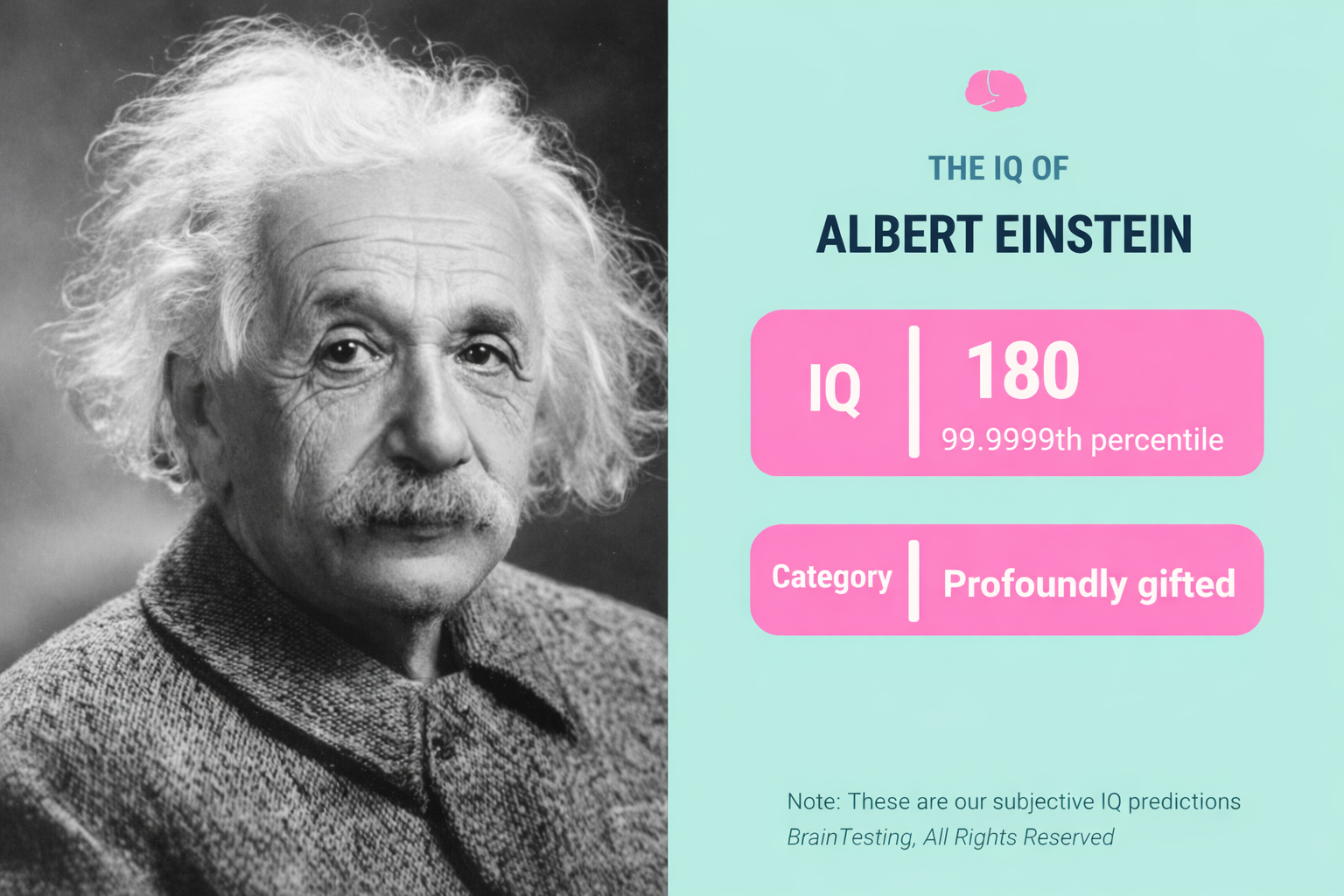
So our estimate is 180 IQ—beyond the 99.9999th percentile — to put that in context, you can read about what the average IQ is and what it means — which falls in the Profoundly gifted range. One of the most exceptional minds ever documented. The human story behind that number — the compass, the patent office, the decade-long siege on relativity — is what makes it real.



.png)
.png)

.png)