.png)



Nicolás Maduro is one of those political figures people often judge too fast. His critics portray him as clueless. His supporters talk as if he is a master strategist forged by history. Both stories are a bit too convenient, aren’t they?
If we want to guess Maduro’s IQ, we have to do something less dramatic and more interesting: follow the evidence in his life. Not the memes. Not the propaganda. The life. And that life gives us a strange mix of signs: limited formal schooling, strong real-world political climbing, moments of genuine negotiation skill, and a style that can look methodical one day and deeply disconnected the next.
So no, we do not have a verified IQ test score for Maduro. But we do have enough biography to make a reasoned estimate. And the case starts in a place no one would confuse with the usual résumé of a head of state.
A future president with a very unconventional education
Maduro was born in Caracas in 1962 and grew up in a left-leaning household. According to a 2024 profile by HuffPost España, he was expelled from high school at 15 for organizing a student protest, later completed his secondary studies, and then took a path that immediately separates him from most national leaders: he did not go on to university.
That detail deserves a pause. Not because university automatically equals intelligence—it does not—but because for a long-serving head of state, the lack of higher education is unusual enough to make you raise an eyebrow. It means we cannot point to elite exams, selective admissions, or years of measurable academic performance as evidence. Those classic IQ clues are simply not there.
We do, however, get other clues. The same HuffPost profile notes that young Maduro stood out as a baseball pitcher and was even said to have received offers to play professionally in the United States. It also mentions that he played bass in a rock band called Enigma. Baseball, music, student protest—honestly, he was one dramatic haircut away from becoming the lead character in a coming-of-age film. More importantly, this does not look like the profile of a passive or mentally slow teenager. It suggests energy, confidence, and comfort performing in front of other people.
The educational picture stayed unconventional. HuffPost España reports that in 1986–87 he studied at Cuba’s Ñico López school for leftist political cadres on a party scholarship. The Associated Press later summarized that period even more bluntly, writing that this was “his only formal education after high school.” That line tells us a lot. Maduro’s mind, whatever its level, was trained politically rather than academically.
And that matters. A person can be quite intelligent without a diploma. But a person without sustained academic records also leaves fewer traces of high abstract ability. So right away, the case points toward something specific: practical intelligence may be on the table; elite scholastic intelligence is much harder to argue.
The bus driver phase is more revealing than it sounds
It is easy to say “former bus driver” with a sneer, as if that settles anything. It does not. In fact, this part of Maduro’s life may be one of the strongest pieces of evidence for his intelligence.
After returning from Cuba, he worked in the Caracas Metro system and became a union organizer. According to HuffPost España, he helped found one of the first unions for Metro workers despite a ban on unions at the time. That is not the behavior of someone with no strategic sense. Organizing workers under institutional pressure requires memory, timing, message control, coalition-building, and a decent radar for who can be persuaded and who will try to crush you. Not exactly Sudoku, true, but intelligence is not only what happens in classrooms.
This is where Maduro starts looking less like a blunt instrument and more like a man with high political adaptability. Union environments are brutal schools for negotiation. You learn how to speak plainly, how to read a room, how to survive conflict, and how to win small victories that build into bigger ones. If you can do that consistently, you almost certainly have above-average verbal and social intelligence.
Remember this section, because it helps explain everything that comes after. Maduro did not climb by dazzling people with academic prestige. He climbed by making himself useful in systems of conflict.
From activist to Chávez insider
By the late 1990s, Maduro had moved fully into electoral politics. HuffPost España traces the climb clearly: he was elected to the old Congress in 1998, then to the 1999 Constituent Assembly, then to the National Assembly in 2000 and 2005, eventually rising to become president of the Assembly. That is not random drift. That is institutional progression.
You can dislike the political system he served—and many people very reasonably do—while still noticing the underlying cognitive fact: people trusted him with larger and larger roles. In politics, that usually means one of three things. You are charismatic, you are useful, or you are dangerous to ignore. Maduro was never considered Chávez-level charismatic, so “useful” becomes the key word. And in political organizations, being repeatedly useful usually means you understand incentives, loyalties, timing, and how to operate without becoming expendable. That is intelligence in action, just not the classroom kind.
The Guardian’s 2013 profile adds an early personality clue from a former classmate, who recalled that Maduro “didn’t speak much,” but “what he did say was usually poignant.” I like that detail because it does not sound like propaganda. It sounds like the kind of observation people make about someone who is careful, restrained, and more deliberate than flashy. That points toward decent verbal judgment and impulse control.
Then comes the biggest clue of all: Hugo Chávez chose him as successor. We should not romanticize that decision, but we should not dismiss it either. Chávez operated in a ruthless political environment and had many loyalists around him. Being selected as heir suggests Maduro had a combination of trustworthiness, ideological reliability, and operational competence that others lacked. You do not get that role by being intellectually empty.
Diplomacy is where the strongest evidence appears
If school gave us only weak signals, diplomacy gives us stronger ones. As foreign minister from 2006 to 2013, Maduro held one of the most demanding jobs in Venezuelan politics. Foreign ministers do not survive on slogans alone. They need memory for people and positions, tolerance for ambiguity, and the ability to negotiate without constantly blowing up the room.
According to The Guardian, Maduro won praise for helping broker peace talks in neighboring Colombia. The same profile quotes Vladimir Villegas, who said Maduro’s union background gave him “incredible negotiating abilities” and that diplomacy had “polished him.” That is unusually direct evidence for practical intelligence. Not mathematical brilliance, not scientific creativity—but real, observed competence in negotiation.
The Guardian also quoted Amherst political scientist Javier Corrales, who called Maduro the revolution’s “most Janus-faced character”: on one side a convinced radical, on the other “soft-spoken and conciliatory.” That is a very revealing description. To be both ideological and tactically flexible is a specific kind of intelligence. Dangerous at times, yes. But still intelligence.
This section is probably the high point of the case for Maduro. If we judged him only by his climb from labor organizer to diplomat, we might place him comfortably above average, maybe more than that. But the same flexibility that helps a politician negotiate does not automatically produce sound judgment when an entire country is on the line.
But then the red flags arrive
Now we have to be honest. The evidence does not all point upward.
Reuters, in a 2018 profile, described Maduro as a 55-year-old former bus driver without a university degree, but that same report is more interesting for the split portrait it captured. Allies described him as “sensible, sencillo, risueño, bastante metódico” and someone who liked to work at night. That sounds like a disciplined operator, maybe even the sort of man who reorganizes chaos at 2 a.m. while everyone else is hunting for coffee.
But Reuters also quoted former Chávez official Ana Elisa Osorio, who said she was shocked by how Maduro could seem “ajeno a la situación” and suggested he had “una desconexión con la realidad.” That is a harsh criticism, but not one we can simply ignore. If several observers see a person as detached from obvious suffering and facts on the ground, that raises questions about judgment, reality testing, and cognitive flexibility.
Then there is the rhetoric. The Guardian noted that Maduro spoke of Chávez’s spirit visiting him as a bird and invoked curses on enemies during the 2013 campaign. You can interpret that as theatrical populism, genuine belief, or both. But whichever option you choose, it does not help the case for a very high IQ. Highly intelligent people can absolutely be superstitious—history is full of them—but repeated use of mystical language in high-stakes politics usually suggests symbolic instinct more than analytical rigor.
So here the case gets messy. Maduro appears capable of strategic behavior and negotiation, yet also prone to rhetoric that makes him sound detached, grandiose, or simply bizarre. Sorry, but there is no psychological law saying one cancels out the other.
Surviving disaster is its own kind of intelligence
Maduro’s presidency has been tied to economic collapse, mass migration, repression, and fierce international criticism. On the merits of governance alone, it is very hard to build a flattering picture of broad analytical intelligence. If a leader presides over years of national wreckage, we should be careful before calling him brilliant. That would be a very strange use of the word.
And yet—and this is the annoying part if you dislike him—politically he survived. For years. Under sanctions, internal dissent, collapsing legitimacy, and international pressure. The AP’s 2026 retrospective summarized a career that went from unionized bus driver to legislator, National Assembly president, foreign minister, vice president, and finally president. People do not usually complete that arc by accident.
Even the AP account, while deeply critical of his record, noted that in 2021 he began implementing measures that eventually ended Venezuela’s hyperinflation cycle. We should not turn that into a halo. But it does suggest that under extreme pressure, Maduro could act pragmatically when ideology alone stopped working. That confirms the pattern we saw earlier in diplomacy: not a grand theorist, but a survivor who can adjust when cornered.
This is why the IQ estimate should not go too low. A truly unintelligent man does not repeatedly outmaneuver rivals, maintain elite loyalty, and adapt just enough to stay in power. But the estimate should also not go too high. His record offers little sign of exceptional abstract reasoning, scientific thinking, or disciplined economic analysis. We are looking at a narrower skill set.
Final prediction: above average, politically cunning, not exceptional
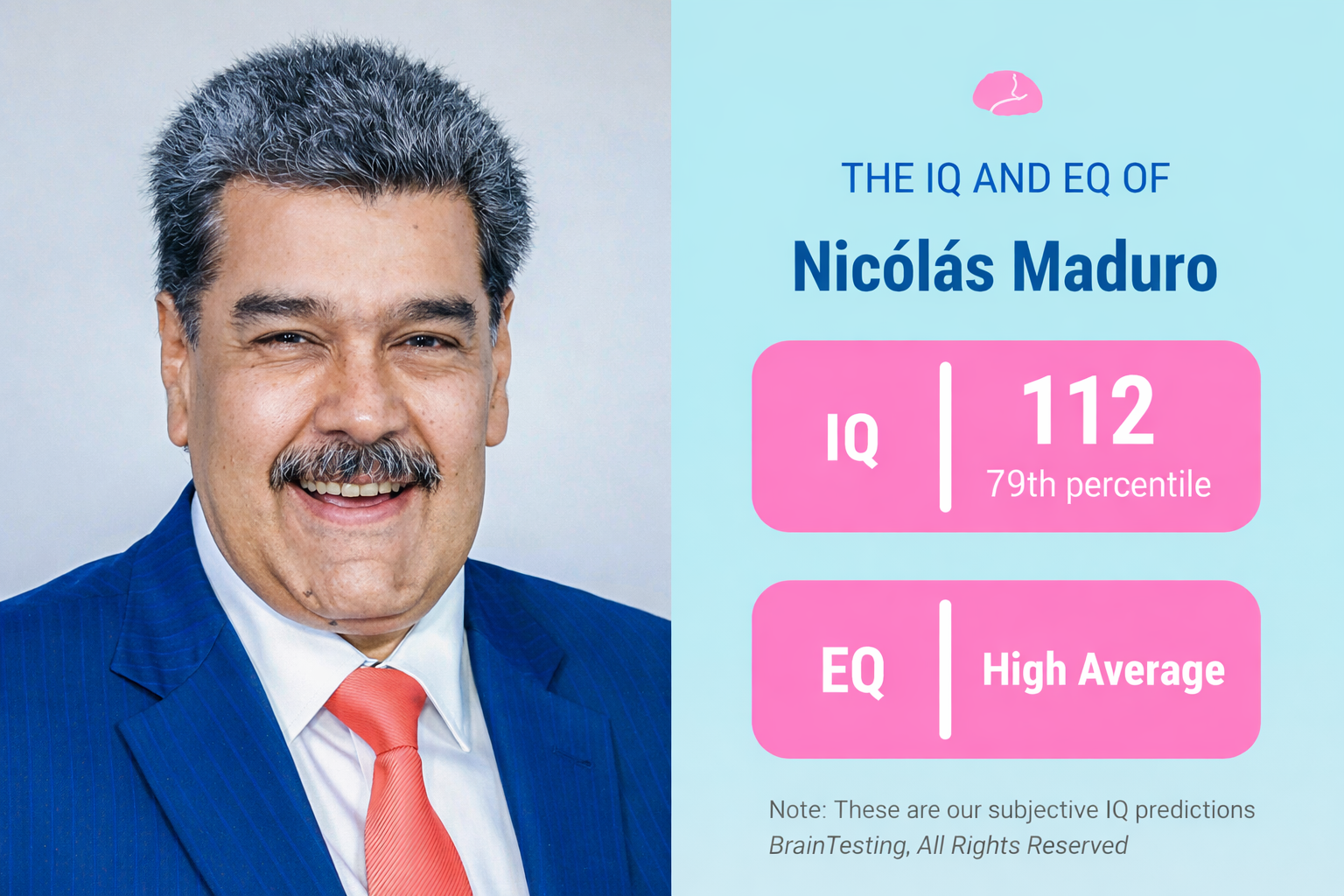
So what is Nicolás Maduro’s likely IQ?
My estimate is 112.
That places him around the 79th percentile, in the High Average range — for context on what those bands mean, see our explainer on the average IQ.
Why 112? Because his life shows repeated evidence of above-average social intelligence — one practical face of general intelligence, or the G factor — verbal control, strategic patience, and political adaptability. Founding unions, rising through a revolutionary movement, serving as foreign minister, earning trust as Chávez’s successor, and surviving in power under extraordinary pressure all point to a mind that is clearly functional, organized, and more capable than casual mockery suggests.
But the case stops there. The absence of a strong academic record does not condemn him, but it does remove a major source of evidence for very high intellectual ability. His public rhetoric sometimes leans mystical or detached. His policy record, especially during Venezuela’s collapse, does not support the idea of a deeply analytical or technically gifted leader. In IQ terms, that keeps him well below the “gifted” band.
One more thing, because it matters: IQ is not the same as wisdom, decency, or governing success. A person can be cognitively above average and still govern terribly. In Maduro’s case, that distinction is doing quite a lot of work.
So we end up with a more interesting conclusion than either fan club or hate club would like. Maduro was probably never a genius. He also was probably never stupid. He looks much more like a man with above-average practical intelligence, strong political instincts, and serious blind spots—exactly the sort of person who can win power, keep power, and still leave a country in terrible shape. Human intelligence, unfortunately, does not guarantee wisdom. If only it did, politics would be much less exhausting.



.png)