.png)
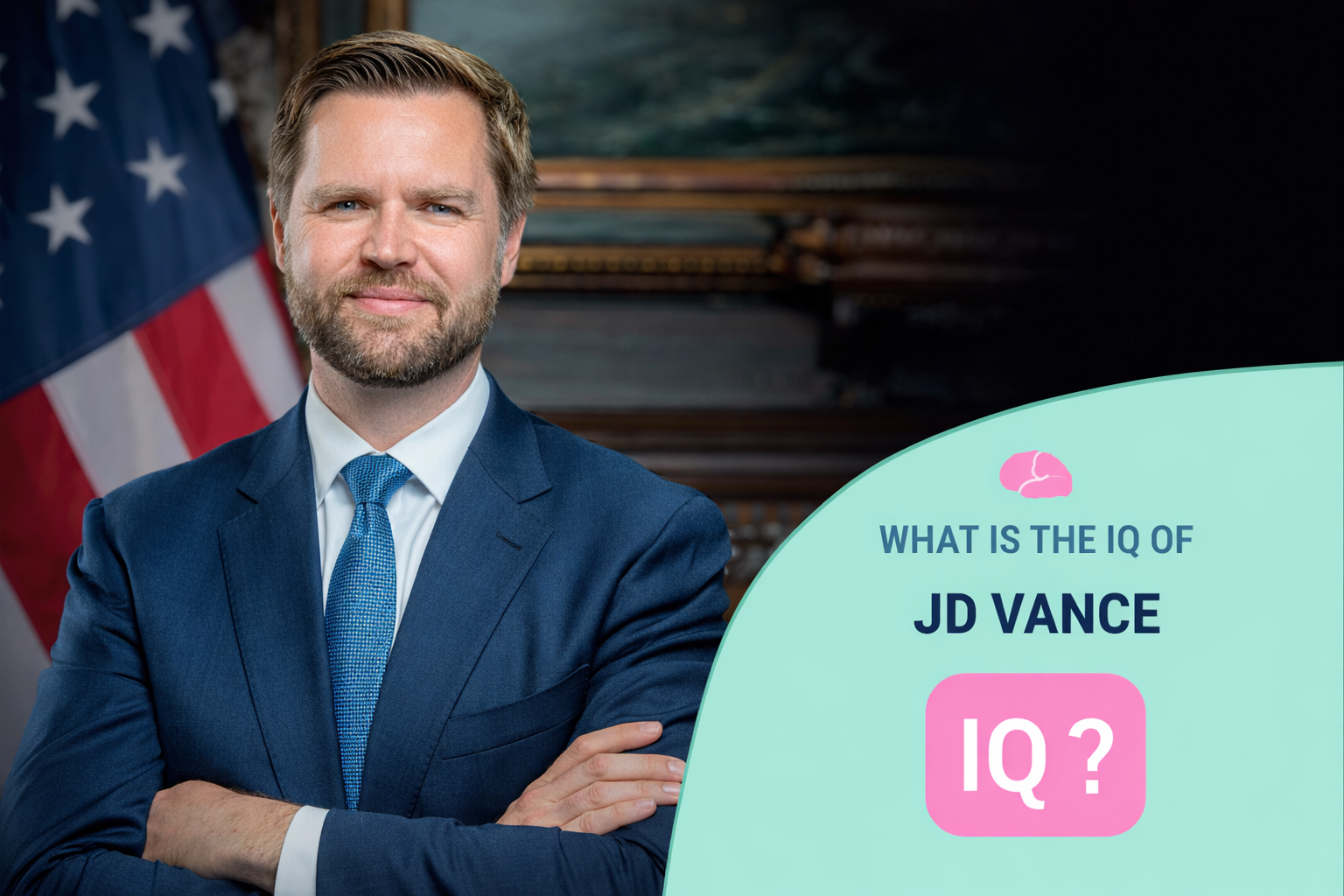


JD Vance is one of those public figures who makes people argue about brains almost by accident. Part of that is the résumé: Marines, Ohio State, Yale Law, bestselling author, senator, vice president. Part of it is the vibe. He can sound like a policy wonk one minute and like a guy who would rather swallow a thumbtack than be called a policy wonk the next. In fact, when American Compass founder Oren Cass introduced him in 2025 as “an intellectual first,” Vance jokingly shot back, “You insult me,” before adding a less printable punchline, as reported by The Daily Beast and AOL. That little moment tells us something already: he knows exactly how he wants to be seen.
So what is JD Vance’s IQ? Nobody knows his actual score. He has never published one, and no verified test result is floating around in public. But we can make an informed estimate by looking at what his life demanded from him and what he kept managing to do, again and again, in very different worlds.
My prediction: JD Vance likely has an IQ around 134. That would place him roughly in the 99th percentile, in the very high range. Not because Yale Law automatically hands out genius certificates (if only admissions were that easy), but because the full pattern of his life points to strong verbal ability, fast learning, strategic thinking, and unusually good adaptation.
First clue: chaos is a brutal teacher
Vance did not grow up in a tidy little pipeline to elite success. According to Hillbilly Elegy, his childhood in Middletown, Ohio was marked by family instability, addiction, and emotional volatility. Britannica’s biography of Vance similarly notes that domestic violence and turmoil were commonplace in the family story he later told, and that his grandmother—Mamaw—provided the stability he needed.
That matters. A child growing up around addiction is often forced to become a weather forecaster of human moods: Who is angry? Who is safe? What will happen next? It is a rough education, and I do mean rough. Hardship does not equal high IQ, so we should not romanticize it. But when someone later turns that confusion into a coherent social analysis, we should pay attention.
One of the most striking lines attributed to his memoir in City Journal is this: “The truth is hard, and the hardest truths for hill people are the ones they must tell about themselves.” You do not have to agree with all of Vance’s conclusions to notice the cognitive skill involved. That kind of sentence requires abstraction. It takes lived mess and compresses it into a general principle. That is a classic marker of high verbal intelligence — one of the building blocks of what psychologists describe as general intelligence, or the G factor.
And then there is Mamaw. Vance repeatedly credits her with giving him the emotional base he needed. Cognitive ability has a much better chance to show itself when somebody, somewhere, makes a child feel life is not just random fire. In Vance’s case, that stabilizing force seems to have kept raw ability from being buried under family chaos.
The Marines: sharpness meets structure
If childhood gave us the first clue, the Marines gave us the second: Vance was trainable, disciplined, and able to function inside a demanding institution. Britannica confirms that after high school he enlisted in the U.S. Marine Corps and served during the Iraq War. That does not tell us he was a math wizard. It tells us something more practical: he could absorb structure and use it.
A lot of intelligent people are messy. Some stay messy forever. Vance seems to have done the opposite. The Marines gave him a system, and he appears to have learned from it fast. That matters for an IQ estimate because high intelligence in the real world often shows up as quick adaptation under pressure, not just pretty test performance in a quiet room.
By the time he left that environment, he seems to have gained exactly what his earlier life lacked: order, habits, and a clearer sense of direction. Put those together with strong underlying ability, and you get the kind of person who suddenly starts moving very fast.
Ohio State to Yale Law: now the evidence gets serious
This is where the case becomes much stronger. According to Britannica, Vance earned a bachelor’s degree in political science and philosophy from Ohio State University in 2009 and then a law degree from Yale Law School in 2013. A 2024 USA Today report published through Yahoo confirms the same timeline.
Let’s be blunt: Yale Law is not a place you drift into because you filled out the form neatly. Admission is brutally selective, and success there usually requires excellent reading ability, abstract reasoning, sustained concentration, and top-tier performance on standardized measures that correlate at least moderately with general intelligence. No, that does not mean every graduate shares the same IQ. Yes, it does mean we are looking at someone from a very cognitively capable slice of the population.
City Journal went further in 2016, arguing that based on the LSAT range associated with Yale Law, Vance’s IQ was “likely north of 140.” I would not present that as fact. It is a commentator’s inference, not a test result, and it is too confident for my taste. Still, the direction is useful. Even if we trim that estimate down, we are nowhere near average territory.
The Washington Post adds something better than prestige: eyewitness texture. In Hannah Natanson’s 2024 profile, an Ohio State peer described Vance as “smart, quiet and punctual.” That is not a flashy quote, but honestly, I like it because it sounds real. “Smart” is the key word. “Quiet and punctual” tells us the intelligence was paired with self-control rather than showmanship. That combination travels well.
He also studied political science and philosophy, which is an interesting pairing. Political science rewards system-level thinking. Philosophy punishes sloppy reasoning when taught well. Together, they suggest he was comfortable dealing with both practical institutions and abstract ideas. Some people collect credentials. This combination suggests he also liked arguments.
Yale taught him more than law
Remember that “smart, quiet and punctual” description, because Yale seems to have revealed another layer: Vance was not just capable in class. He learned the social code of elite spaces very quickly.
According to The Washington Post, a Yale Law classmate said Vance “wasted no time in figuring out how to plumb” the school’s vast resources. That line matters a lot. High IQ is not only about solving difficult problems in private. It is often about spotting the hidden rules in a new environment and acting on them faster than other people. Yale is full of talented students. The ones who rise fastest are often the ones who decode the institution itself.
That pattern fits what we saw earlier. As a child, Vance had to read unstable adults and shifting conditions. In the Marines, he learned formal systems. At Yale, those two skills met the American elite. And he adapted—quickly. That is not proof of genius, but it is strong evidence of high-level social and strategic intelligence.
This is where people underestimate him. They look at the hillbilly-to-Ivy-League storyline and focus only on grit. Grit matters. But grit alone does not explain why some people enter an elite institution and remain overwhelmed while others map the place in weeks. Vance appears to have done the latter.
Then he wrote a book that millions of people actually read
Many smart people can survive law school. Far fewer can write a book that reshapes a national conversation. In 2016, Vance published Hillbilly Elegy, the memoir that made him famous. Britannica notes that the book became a bestseller, and its success was not just political luck. It required narrative skill, memory, argument, and the ability to package personal experience into something large audiences could understand.
This is one of the strongest clues in the whole case, in my view. Writing a successful memoir is not merely “having thoughts.” It demands organization. It demands knowing which details matter, which ones to cut, and how to move from anecdote to thesis without losing the reader. Vance’s prose in the book is not ornate, but it is clear and forceful. That points to strong verbal reasoning more than to flashy literary genius.
According to his own book, the point was not to brag about escaping poverty but to describe “what goes on in the lives of real people when the industrial economy goes south.” Whether you agree with his politics is a separate issue. The sentence itself shows compression, framing, and conceptual reach. He was taking biography and turning it into a national argument. That is cognitively demanding work.
And here we should add a small reality check: bestselling books are not IQ tests. Plenty of brilliant people write unreadable books, and plenty of simpler books sell like hotcakes. But when one person combines elite legal education with persuasive public writing, the pattern starts to look less accidental.
The anti-intellectual act is part of the intelligence
Now we get to one of the more entertaining contradictions in the Vance story. He has the background of an intellectual, writes like one, and networks like one—yet he visibly resists the label. As reported by The Daily Beast, when Oren Cass praised him as someone who “was an intellectual first,” Vance replied, “I come here for free, and you insult me.” It was a joke, yes, but jokes are often little windows with better lighting.
Why reject the label? Because Vance seems to understand that in his political world, “intellectual” can sound like “detached elite.” He does not want detached elite. He wants insider-outsider. Smart enough to run the room, normal enough that the room does not resent him for it.
That, frankly, is intelligent behavior. Maybe not morally uplifting, depending on your politics—but intelligent. It shows audience awareness, symbolic control, and the ability to shape identity on purpose. The Washington Post profile makes a similar point in a less funny way: Vance was seen as someone who could move between worlds, simultaneously using elite institutions and signaling distance from them.
There is a pattern here. He does not only think well. He seems to think about how thinking itself is perceived. That is one reason I would not base his IQ estimate only on education. His social intelligence boosts the case.
So is he a 140-plus genius?
I would stop short of that. City Journal’s claim that his IQ is “north of 140” is memorable, but it leans too heavily on admissions proxies and a commentator’s confidence. High LSAT-type performance does suggest strong reasoning ability, but converting elite credentials directly into an IQ score is a neat trick, not a scientific measurement.
Still, going too low would make even less sense. Average intelligence does not plausibly explain this combination of achievements: surviving severe instability, adapting to the Marines, excelling at Ohio State, reaching Yale Law, writing a major memoir, and then building a career in law, finance, media, and politics. Add the classmate descriptions, the verbal sharpness, and the speed with which he learned elite codes, and the picture becomes pretty clear.
So where does that leave us? In my view, JD Vance most likely falls in the low-to-mid 130s. That is high enough to place him clearly among the intellectually gifted relative to the general population, but cautious enough to avoid pretending that every politically successful Yale graduate is a hidden Einstein (the republic has survived enough overconfidence already).
Final prediction
Our estimate for JD Vance’s IQ is 134.
That places him around the 99th percentile of the population — for context on what that actually means in a normal distribution, see our explainer on the average IQ — in the very high intelligence range.
The case rests on several converging clues: elite academic performance, strong verbal ability, disciplined self-reinvention, quick adaptation to radically different environments, and an unusual talent for reading both institutions and audiences. The last point matters. Vance does not just seem smart in the classroom sense. He seems strategically smart—the kind of person who learns the game, then learns how to pretend he is not playing it.
Which brings us back to that opening joke about being “insulted” by the word intellectual. It was funny because it was useful. JD Vance looks very much like a highly intelligent man who knows that sounding smart and sounding elite are not the same thing. IQ cannot tell us whether that is wise, admirable, or dangerous. But it does suggest he knows exactly what he is doing.




.png)