.png)
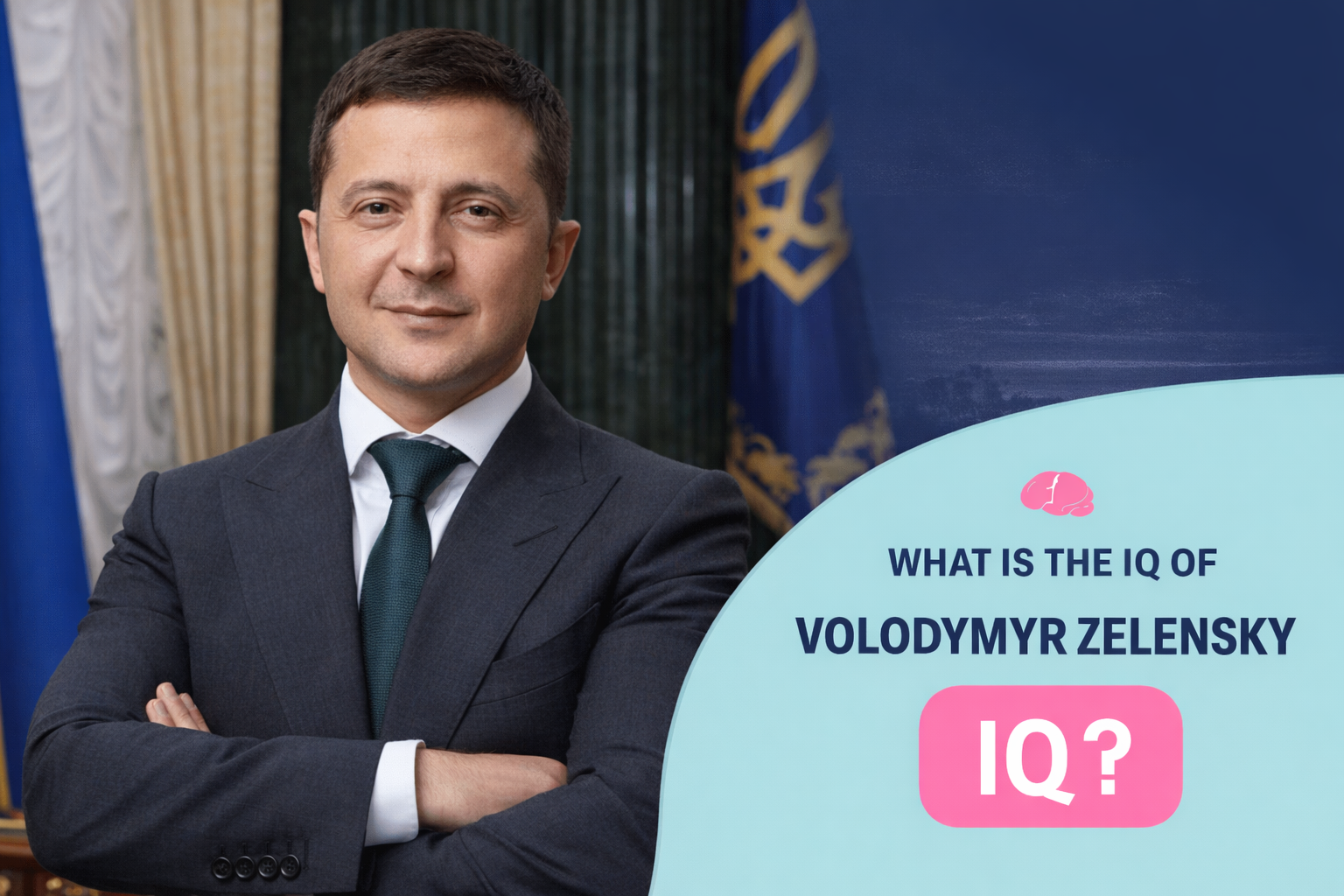


Volodymyr Zelensky has one of those biographies that make people misjudge him twice. First, they see “comedian” and underestimate him. Then they see “wartime president” and start speaking as if he were a myth carved out of marble. The truth is more interesting. He looks like a very intelligent man whose mind was shaped by law, language, comedy, media production, and then tested in the hardest arena possible: real war.
Before we build the case, we need to throw one thing out the window. There is no credible public IQ score for Zelensky. None. StopFake reported in 2024 that one widely shared “study” claiming low IQ scores for Ukrainians was completely fabricated, and Informator later described similar online IQ rankings as manipulation tied to scam-like paid tests. So if you have seen a neat little number floating around social media, treat it the way you would treat a miracle diet tea: with suspicion and maybe a raised eyebrow.
That does not mean we are helpless. IQ is not the same thing as achievement, but achievement leaves footprints. Education does. Language learning does. Running a major creative company does. So does staying mentally sharp while your country is being bombed. And if we follow those footprints carefully, the trail gets pretty hard to ignore.
A tough city, a serious family, and an early clue about resilience
Zelensky was born in Kryvyi Rih in 1978, an industrial city with a rough reputation. In TIME, Simon Shuster described the city as a hard place shaped by the brutal transition out of the Soviet era, and noted that Zelensky, “thanks in large part to his family,” avoided the pull of the streets. That matters more than it may seem. Intelligence is not only what you can solve on paper; it is also how well you navigate your environment. A kid who stays focused in a chaotic setting is often showing some combination of self-control, social reading, and long-term judgment.
The same TIME profile quoted Zelensky describing Kryvyi Rih as giving him “my big soul, my big heart.” That line is not an IQ clue by itself, of course. But it does point to something we see repeatedly in his public life: he thinks in emotionally vivid, memorable language. Good communicators do not just know things. They package them.
That pattern becomes clearer when we move to his teenage ambitions. And here the story gets unexpectedly nerdy—in a good way.
The teenager who wanted diplomacy, not punchlines
Long before he played a fictional president, Zelensky reportedly wanted to become a diplomat. In a 2019 interview summarized by TVC.ru and BFM.ru, he said that at school he wanted a diplomatic career and was deeply interested in international negotiations. That is a pretty specific dream for a teenager. Most teenagers are trying to survive algebra and bad haircuts. Zelensky was apparently drawn to negotiation, languages, and international affairs.
According to Fakty ICTV, he studied in a strong English track, passed the TOEFL at 16, and even received a scholarship to study in Israel, though he did not go. We should not overstate this into “child prodigy” territory, because that would be sloppy. But passing TOEFL that young and winning a scholarship opportunity strongly suggests verbal ability, discipline, and academic promise.
There is one useful complication here. In 2019, NV gathered teachers’ impressions of Zelensky’s spoken English and found it was functional but far from dazzling. Good—this actually helps us. It keeps us from turning one teenage TOEFL result into a fairy tale. The better interpretation is that Zelensky had real language aptitude and ambition, but like many adults, he developed unevenly and pragmatically. That still counts as evidence of intelligence, just not magical intelligence.
And then comes one of the more telling twists in his life: he did the respectable thing on paper, got the law degree, and then ignored the obvious career path.
When a law graduate walks away from law, pay attention
According to both Fakty ICTV and the official biography on the website of the President of Ukraine, Zelensky studied law at Kyiv National Economic University from 1995 to 2000 and qualified as a jurist. He never really practiced, apart from some training experience. Now, a law degree alone does not prove a sky-high IQ. Plenty of bright but ordinary people get law degrees. But it does tell us something important: he could handle abstract rules, sustained study, and complex verbal material.
More interesting, though, is what he did next. He did not cling to the prestige of law. He pivoted into comedy and entertainment. That might sound like a move from “serious intelligence” to “soft intelligence,” but that would be a huge mistake. In cognitive terms, comedy can be brutal. Timing, wordplay, audience reading, memory, improvisation, and rapid reframing all happen at once. If courtroom argument is structured intelligence, comedy is high-speed intelligence with the lights flashing.
Remember that early fascination with negotiation and language? It did not disappear. It just found a stranger stage.
Comedy is not the opposite of intelligence. Often it is the giveaway.
The official presidential biography notes that from 1997 to 2003 Zelensky worked as an actor, screenwriter, and artistic director for the KVN team Kvartal 95, and then led Studio Kvartal 95 for years after that. Those are not decorative credits. Writing and performing successful comedy at scale is one of the clearest real-world signs of mental quickness we have.
Why? Because comedy rewards fast pattern detection. You notice hypocrisy before other people do. You hear the weak point in an argument before the speaker reaches the end of the sentence. You know what an audience expects—and then you twist it half a second early. That kind of thinking does not always show up on an IQ test, but it is definitely adjacent to the machinery IQ tests are trying to measure.
And Zelensky was not just a performer delivering lines someone else handed him. According to the official biography, he spent years as a writer and artistic leader. That means generating ideas, shaping scripts, managing talent, revising material, and making split-second judgments about what works. Comedy writers are often walking laboratories of cognitive flexibility. Exhausting dinner guests, perhaps, but cognitively flexible.
If this had been the whole story, I would already place him comfortably above average. But Zelensky did something else, and it matters a lot: he turned creative skill into organized output.
Running Kvartal 95 takes more than charm
Fakty ICTV reports that Zelensky was co-owner and artistic director of Studio Kvartal 95 from 2003 to 2019, and the official biography adds that he briefly served as general producer of the TV channel Inter. That combination is telling. Plenty of clever people are chaotic. Plenty of funny people cannot run a team. Plenty of performers are brilliant on stage and scattered everywhere else. Zelensky seems to have had enough executive control to build, manage, and scale a media operation.
The numbers here help. According to the official biography, he has 10 feature films in his creative record and more than 30 Teletriumph awards from Ukraine’s national television prize. Awards are not IQ points, obviously. But sustained, high-volume, high-recognition output is evidence of planning ability, stamina, and the capacity to coordinate many moving parts. Creative talent is one thing. Creative talent that survives deadlines, budgets, and teams is another.
This is also where his profile begins to look broader than that of a merely witty performer. We are seeing not just sharp language, but leadership, decision-making, and what psychologists would call cognitive endurance. He could think, and he could keep thinking under pressure for years.
Then he made the leap that turned satire into an audition.
Servant of the People was more than a TV hit
Zelensky’s starring role in Servant of the People made him internationally recognizable before politics did. But the most interesting thing here is not that he played a president. It is that he and his team built a narrative that captured public frustration with corruption so precisely that fiction became politically plausible. That requires more than charisma. It requires sharp social perception.
He understood, or at least helped articulate, what millions of people were ready to hear: that politics had become absurd, stale, self-serving, and vulnerable to mockery. Satire works only when it mirrors reality closely enough to sting. If your read on the culture is shallow, the joke dies. Zelensky’s didn’t.
There is also a harder cognitive trick inside political satire: you have to simplify without becoming simplistic. You distill a messy system into scenes, symbols, and jokes that ordinary people instantly grasp. That is a serious intellectual skill. In some ways it resembles what he later had to do as president for real—translate complexity into clarity while keeping the emotional truth intact. We should not ignore how strange and impressive that is.
So by the time he entered politics for real, the case for high intelligence was already substantial. He had academic evidence, language evidence, creative evidence, and executive evidence. But none of that is the strongest clue. The strongest clue came later, when cleverness stopped being entertaining and started being necessary for survival.
Under invasion, the mind gets exposed
Once Russia launched its full-scale invasion, Zelensky’s mind became visible in a different way. Under extreme stress, people simplify. They freeze, ramble, detach, or collapse into slogans. Zelensky, by contrast, repeatedly communicated with clarity, emotional precision, and strategic intent. That is not proof of genius, but it is powerful evidence of very high functioning. Honestly, it is hard not to be impressed by the steadiness of it.
Think about what wartime communication demanded from him: speaking to Ukrainians, foreign parliaments, journalists, military audiences, and ordinary citizens around the world; adjusting tone without losing message; compressing complex military and political realities into language that moved people; and doing all of that while sleep-deprived and under threat. You do not fake that for very long.
His earlier life suddenly makes more sense here. The kid interested in negotiations. The law graduate trained in structured argument. The comedian skilled in timing and audience reading. The producer who knew how to build a message and a team. All of those abilities converged in office.
Even his imperfections are informative. His English, for example, was never sold by credible observers as native-level brilliance. Yet he has communicated internationally well enough to persuade, reassure, and lead. That tells us something psychologically important: he is highly adaptive. He does not seem trapped by the ego need to perform perfection. He aims for effectiveness. In leadership, that can be smarter than polish.
There is also the matter of emotional intelligence. According to TIME, stories from his grandfather’s wartime experience left a deep mark on him. Whether in speeches or in short direct video messages, Zelensky often communicates with an unusual blend of moral seriousness and accessibility. He can sound grave without sounding abstract. Again, that is not a standard IQ subtest, but if you are trying to estimate how mentally capable someone is in the real world, it matters enormously.
So what is Volodymyr Zelensky’s IQ?
We obviously do not know his actual score, and anyone claiming certainty is selling something—possibly a fake test for $3. But based on the evidence, we can make a serious estimate.
Zelensky appears to sit well above the general population in reasoning speed, flexibility, social perception, and strategic communication. His law degree and early TOEFL success suggest strong academic ability. His years as a comedy writer and producer suggest very fast verbal processing and pattern recognition. His leadership of Kvartal 95 points to planning and executive skill. And his wartime presidency shows exceptional adaptability under pressure.
At the same time, we should be careful not to inflate him into a once-in-a-century scientific genius. His profile is not Einstein or Tesla. It does not even look quite like Barack Obama’s more traditionally elite academic-intellectual path. Zelensky’s intelligence looks more practical, verbal, creative, and situational.
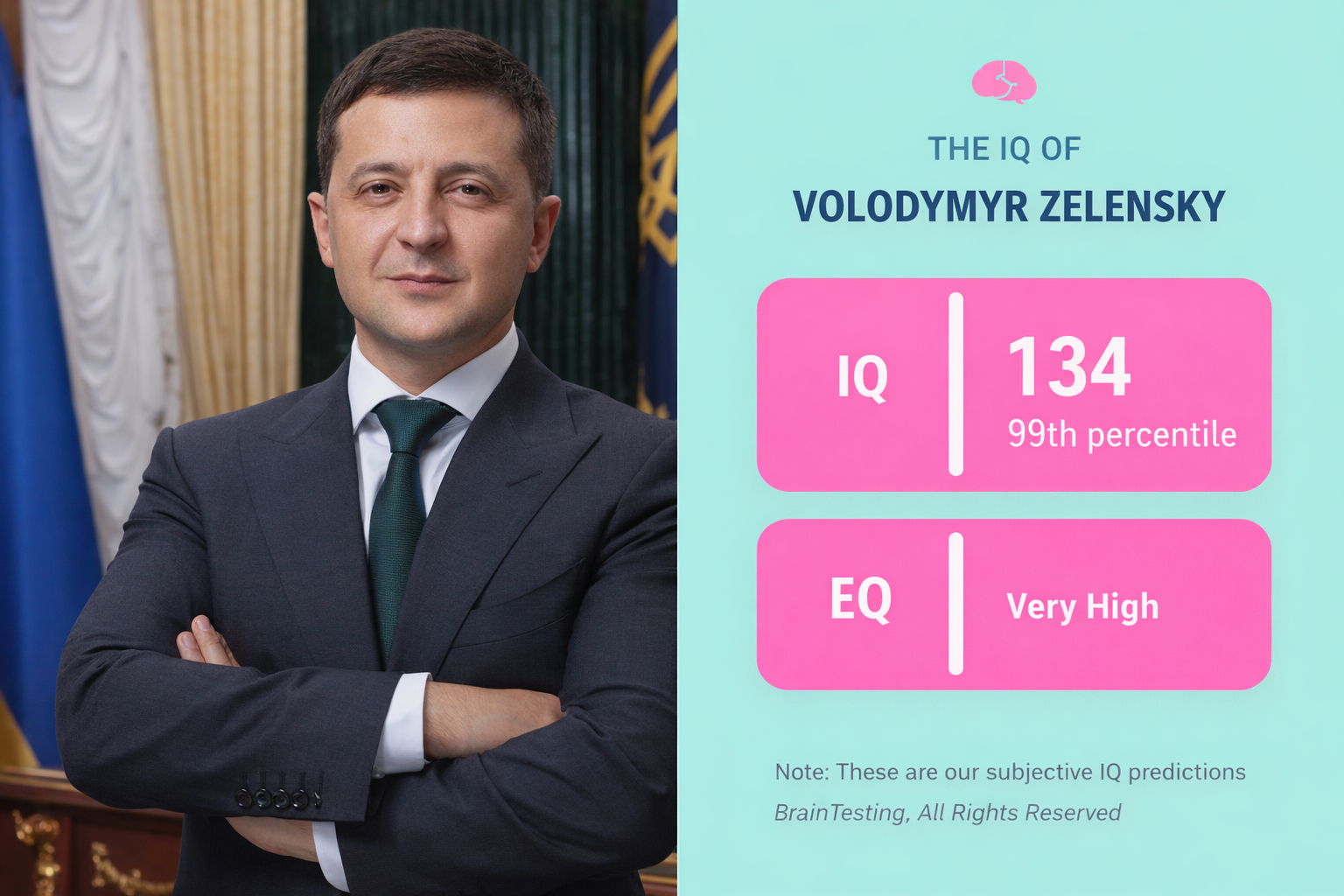
Our estimate: 134 IQ.
That would place him around the 99th percentile, in the Very High range. In plain English: smarter than about 99 out of 100 people, with especially strong gifts in communication, improvisation, persuasion, and high-pressure decision-making.
And honestly, that number fits the story. A teenager aiming for diplomacy. A law graduate who chose comedy. A comic who built a media empire. A performer who became a president. A president who, under invasion, showed the world that wit and seriousness are not opposites. Sometimes they are the same mind, just under different lighting.



.png)


