.png)
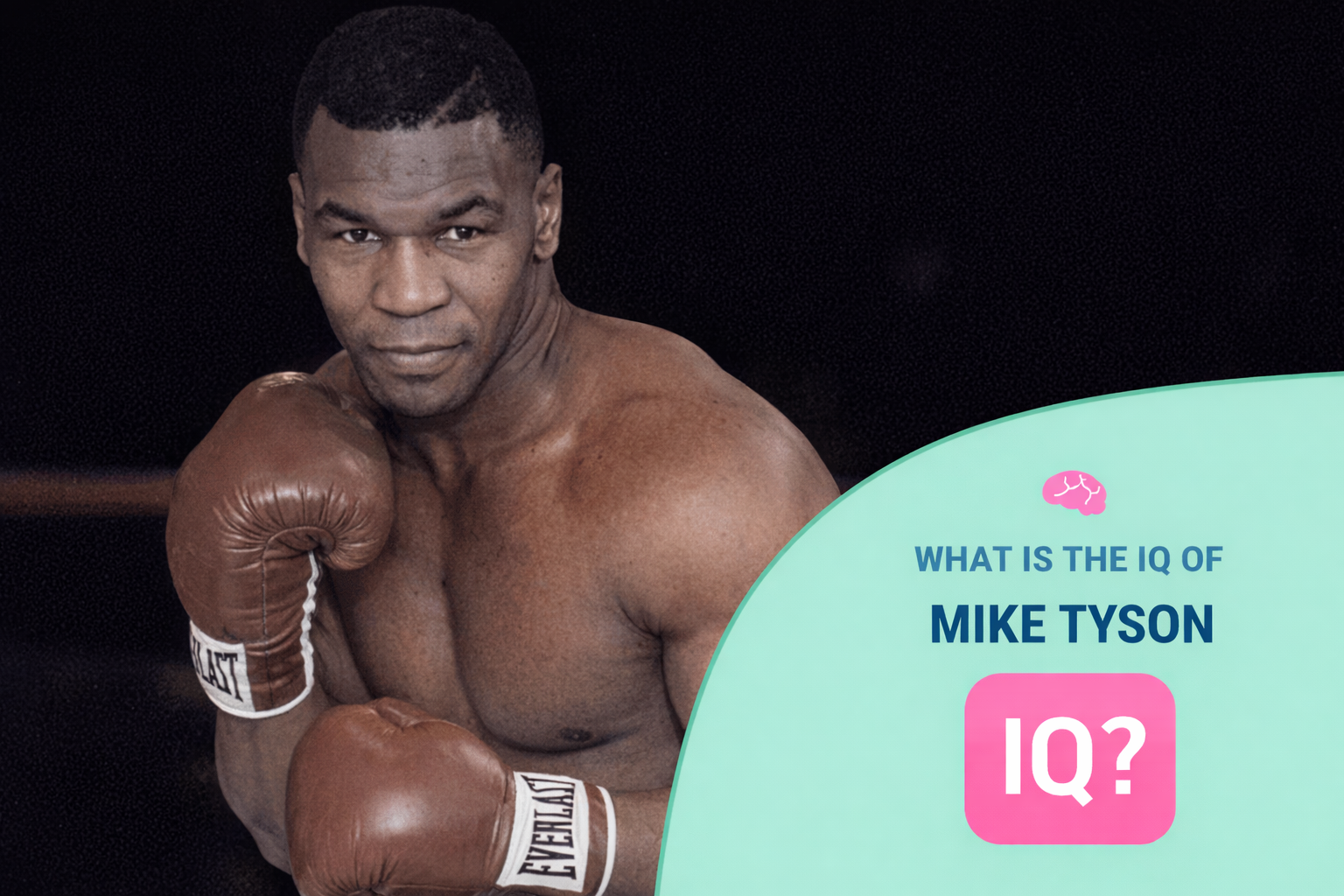


Mike Tyson has spent most of his public life being underestimated in one very specific way. People saw the knockouts, the lisp, the explosions of rage, the prison sentence, the tabloid chaos—and many quietly filed him under dangerous, but not very bright. That was always too simple. Honestly, far too simple.
Because if Mike Tyson were merely a brute, he would not have become the youngest heavyweight champion in history. He would not have mastered one of boxing’s most cognitively demanding styles. He would not have spent later years talking about fear, ego, identity, and self-destruction in language that is often more philosophical than many celebrities manage on their best day.
So what could Mike Tyson’s IQ actually be? No verified public score exists. And that matters. Tyson underwent psychological and neuropsychological evaluation in 1998, according to ESPN’s publication of his medical evaluation documents, but those records do not provide a public standard IQ score. So we have to build the case the old-fashioned way: from the life itself.
And Tyson’s case is a fascinating one, because it begins in a place where intelligence can hide very easily: fear.
The boy people misread
Tyson’s early life did not look like the biography of a future “smart” person in the conventional sense. Jack Newfield wrote in The Village Voice in 1985 that Tyson was a good student at first, but by fifth grade had become “a chronic truant.” That one line tells you a lot. School stopped being a stable channel for his development very early.
Why? Partly because school, for Tyson, was not some warm little ladder into middle-class success. It was chaos. As Tyson later said on his podcast, quoted by EssentiallySports in 2023, “I went there – I got my a** beat all the time.” If that was your classroom experience, you probably would not come out loving algebra either.
Then came reform school. According to Ivan Solotaroff’s 2010 profile in The Guardian, Tyson was so withdrawn at Tryon School that many there assumed he was mentally impaired. Solotaroff writes that some “had simply assumed the huge boy was mentally retarded.” That is one of the most revealing facts in Tyson’s whole story. Adults were reading trauma, muteness, and explosive behavior as low intelligence. It happens all the time, and it is one of the oldest mistakes in the book.
In psychology, we’d call that a measurement problem. In plain English: when a kid is terrified, bullied, angry, and barely speaking, you are not seeing clean evidence of his actual cognitive potential. You are seeing survival mode. Tyson’s youth is a loud warning against treating early school performance as destiny.
Still, we should not overcorrect. A rough childhood does not automatically make someone a hidden genius. What it does mean is that low academic output tells us less than usual. So if school cannot carry the case, what can? Boxing. Very clearly, boxing.
Boxing became his real education
The first people who recognized Tyson’s mind did not do it through test scores. They did it through coaching.
Newfield reported in The Village Voice that when Tyson arrived at Tryon, he was described as “violent, depressed, and mute.” But that same piece shows the pivot: Tyson discovered boxing there, and then Bobby Stewart connected him to Cus D’Amato. That relationship changed everything.
D’Amato did not just teach Tyson how to punch. He taught him how to think in a ring. And those are not the same thing, despite what every lazy sports stereotype would have you believe. Tyson later told Maclean’s that Cus was “a walking encyclopedia” who used writers like Dostoevsky, Tolstoy, Twain, and Hemingway to explain psychology. Read that sentence again. Tyson’s formative mentor was not only drilling combinations; he was framing boxing through literature and human nature. That is not a normal coaching environment.
More importantly, Tyson absorbed it. That is the key. Plenty of teenagers sit near smart adults and absorb approximately nothing. Tyson absorbed enough to translate fear into style, discipline into routine, and instruction into devastating performance before age 20. Britannica notes that he became heavyweight champion at just 20 years old, and that fact is not just athletic trivia. To reach the top of boxing that young, especially in the heavyweight division, requires tactical maturity, unusual learning speed, and the ability to perform under extraordinary pressure.
And here we arrive at one of the clearest clues in the whole article: Tyson’s intelligence appears strongest in fast learning under pressure. That is a real form of intelligence, even if it will never win applause from a school counselor with a stack of standardized tests.
His ring IQ was not just good. It was elite.
Now we get to the heart of the case.
Tyson was not a giant heavyweight leaning on reach and size. He was usually the shorter man. That matters because it meant he could not solve the problem in the easy way. He needed to close distance, slip punches, read patterns, and launch combinations in tiny windows of time. In other words, he had to think faster and more precisely than men who often had simpler physical advantages.
The peek-a-boo style he learned under D’Amato looks violent—and it was—but it was also deeply technical. Constant head movement. Angle changes. Split-second anticipation. Body-head combinations. Defensive reactions feeding directly into counters. A fighter who cannot process patterns quickly gets hit. A fighter who cannot remember sequences gets trapped. A fighter who cannot predict habits becomes a highlight reel for someone else.
Tyson, instead, became the highlight reel.
This is where the IQ conversation around him usually goes wrong. People hear IQ and picture vocabulary quizzes or little number puzzles. Fair enough. But a lot of real-world intelligence is pattern recognition, timing, strategic adaptation, and learning speed — most of what psychologists bundle into what we explored in our piece on general intelligence, or the g factor. Tyson showed all of that at a world-class level. Not average. Not “pretty good for an athlete.” World-class.
Even Tyson’s critics often end up admitting this accidentally. They call him explosive, instinctive, animal-like. But “instinctive” at that level is very often compressed expertise. It is what intelligence looks like after thousands of repetitions have been organized into fast, reliable judgment. The man was making advanced decisions at fighting speed while another trained heavyweight tried to remove his head. Sorry, but that counts.
Does that mean genius-level IQ? No. But it pushes him well above average in at least some cognitive domains.
The evidence that keeps us honest
If we stopped there, we would risk turning Tyson into a myth of pure hidden brilliance. His life does not support that either.
Tyson’s formal education remained extremely limited. An Associated Press report published by Deseret News in 1992 noted that Tyson had dropped out of school as a youth, never received a high school diploma, and chose to leave prison classes because he “didn’t like school.” That is not proof of low IQ, but it is evidence that structured academic learning was never his strength—or at least never became one.
We also have to note the public rumors about his GED and supposed academic incompetence. Here the record gets messy. In 1994, Mark Asher reported in The Washington Post that a widely circulated story claiming Tyson had failed GED math questions was built on bogus material; the American Council on Education said the published questions were not real GED items. So we should throw that cheap anecdote in the trash where it belongs.
But cleaning up a false story does not magically make Tyson an academic thinker. His life suggests something more uneven and more human: high practical and strategic intelligence, weaker traditional academic engagement, and some major blind spots in judgment.
One blind spot was money. Tyson earned fortunes and burned through them. He later became a case study in how somebody can be a genius in one arena and a disaster in another. That matters for our estimate. Truly high-IQ people can absolutely make horrible financial choices, of course. But repeated catastrophic decision-making across years does pull against putting Tyson in the uppermost brackets.
Then there is impulse control more broadly. Intelligence is not morality, and it is not self-mastery. Tyson’s story includes violence, crime, addiction, and ruin. Some of that reflects trauma, exploitation, and environment. Some of it reflects poor judgment. Both can be true at once. If we are being rigorous, we have to count both the sophistication and the wreckage.
Then the older Tyson starts talking
And this is where the picture gets unexpectedly rich.
The older Mike Tyson you meet in long interviews is not the caricature many people still carry around from the late 1980s. He is often funny, self-lacerating, reflective, and oddly philosophical. Remember those adults at Tryon who thought he was mentally impaired? The later interviews make that judgment look absurd.
In Maclean’s, Tyson said, “I’ve always self-analyzed my life. I do that every day.” Frankly, lots of famous people say versions of that. Tyson is one of the few where you read the interviews and think: yes, he actually does.
In that same Maclean’s interview, he said, “I can’t remember anything that happened yesterday. But I remember everything that happened 100 years ago.” Hyperbole? Obviously. But it hints at something real: Tyson appears to have unusually strong emotionally charged long-term memory, especially for formative experiences and lessons. That kind of memory often feeds both ring anticipation and personal storytelling.
He also developed an appetite for reading that would surprise anyone still stuck in the old stereotype. Tyson discussed the influence of Cus introducing him to major writers, and multiple profiles over the years have described him reading philosophy, history, and literature. In prison, he became known for devouring books. You do not need to pretend he turned into a tenured professor (imagine the office hours), but the evidence strongly suggests genuine intellectual curiosity.
Solotaroff’s The Guardian profile captures another important dimension: Tyson’s ability to think about identity and illusion. In one moment after not being recognized, he recalls thinking, “My whole life must’ve been a lie … Who am I?” That is not the language of a vacant mind. That is a man grappling—sometimes painfully—with the difference between persona and self.
The KNBR interview transcript published by SFGate shows the same tendency. Reflecting on his downfall, Tyson said it was “me destroying myself,” then added that you feel “the same power destroying yourself as building yourself up.” That is a striking bit of psychological insight. Dark, yes. But insightful. He is describing the seductive energy of self-destruction using a mirrored concept. Plenty of highly educated people never say anything half that sharp.
And in the 2022 Spin interview, Tyson mixed humility, humor, and existential thought in a way that feels very him. At one point he joked, “Oh, I’m so stupid, forgive me God.” It is funny, but also revealing. Tyson often performs self-mockery while discussing very large themes—death, meaning, power, regret. He is more verbally agile than the stereotype allows.
Our estimate: Mike Tyson’s IQ
By this point, the shape of the answer is pretty clear.
Tyson shows strong evidence of elite domain-specific intelligence: extraordinary pattern recognition, spatial timing, anticipation, learning speed, and tactical adaptation in boxing. He also shows meaningful emotional insight, vivid metaphorical thinking, and later-life verbal reflectiveness. At the same time, there is little evidence of broad academic achievement, quantitative excellence, or the kind of sustained cross-domain analytic performance that would justify putting him near Barack Obama or Lady Gaga in the BrainTesting library.
So no, we are not putting Mike Tyson at 138. And we are definitely not putting him in the Einstein galaxy unless everyone in the galaxy has been punched very hard.
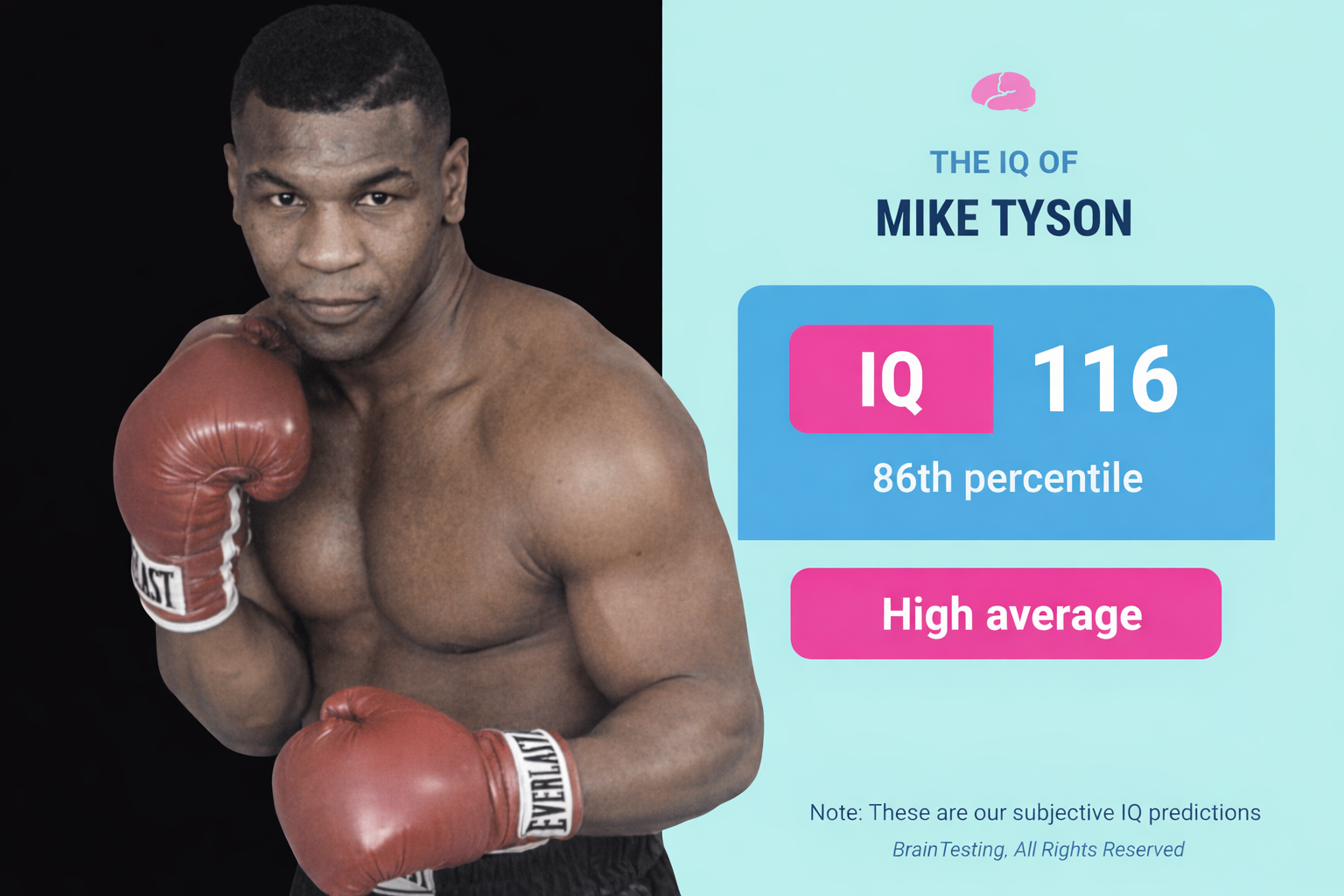
Our estimate is that Mike Tyson’s IQ was likely around 116.
That would place him roughly in the 86th percentile, in the High average range.
Why 116 specifically? Because it fits the mixed evidence. It is high enough to reflect the very real sophistication of his ring intelligence, memory for patterns, and later self-analysis. But it is not so high that we have to ignore his weak academic record, inconsistent judgment, and patchy evidence outside the domains that mattered most to him.
If you want the shortest version, here it is: Mike Tyson was smarter than his image, less academic than genius narratives might hope, and far more cognitively interesting than the stereotype ever allowed. He did not look like intelligence in the classroom. He looked like it slipping a jab, reading a man’s habits, and later staring into the wreckage of his own life and actually learning something from it.



.png)