.png)
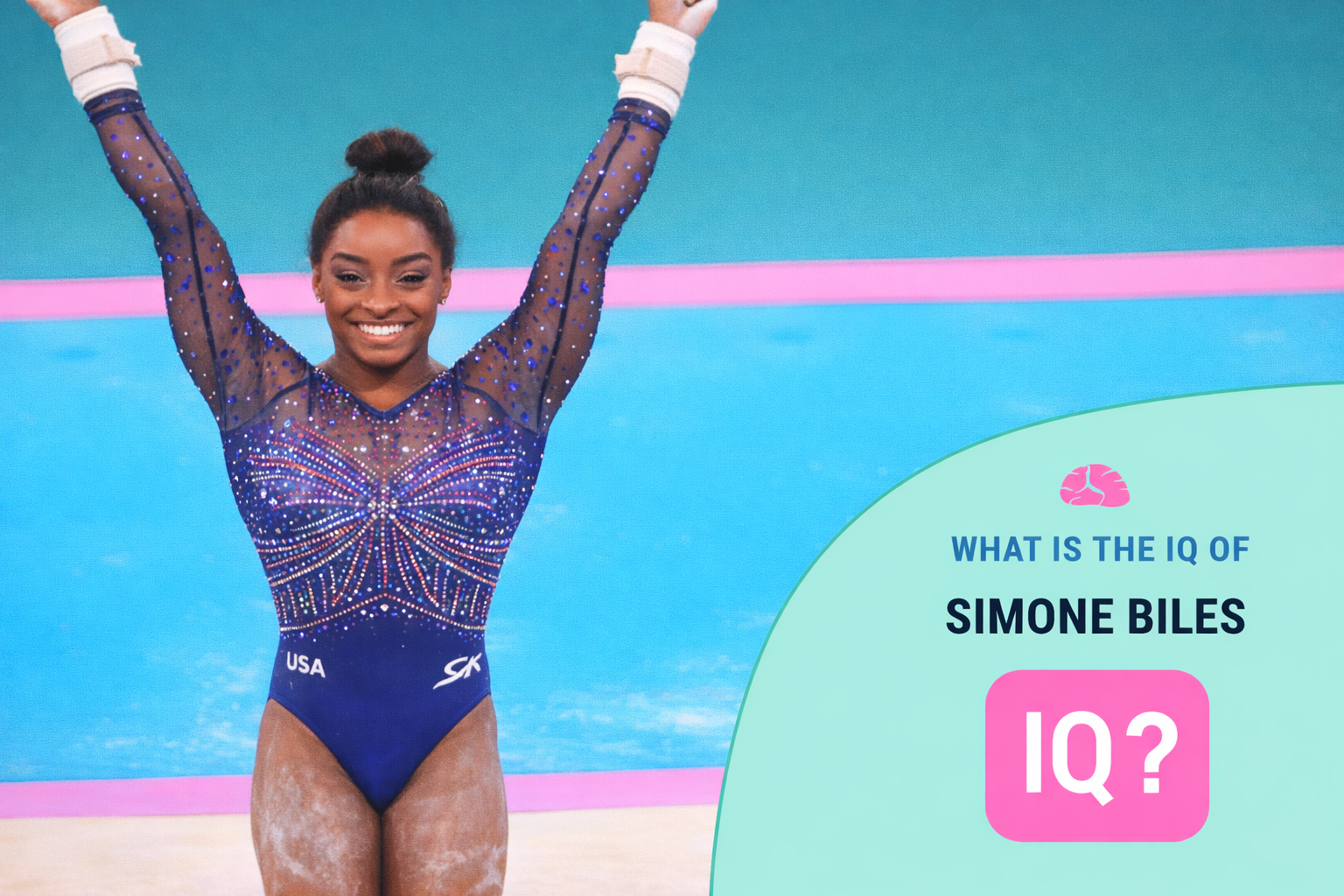


Simone Biles does not need an IQ test to make you feel intellectually inadequate. She can launch herself into the air, rotate at alarming speed, and know mid-flight whether the vault is right. Most of us, meanwhile, misjudge the last step on the stairs and act like it was the stairs’ fault.
So what is Simone Biles’s IQ? No public record shows that she has ever shared a score. That means we have to do this the interesting way: by building a case from her life. And Biles gives us a lot to work with—resilience, unusual learning demands, elite spatial reasoning, creativity, emotional control, and the kind of self-awareness that probably saved her career and maybe her neck.
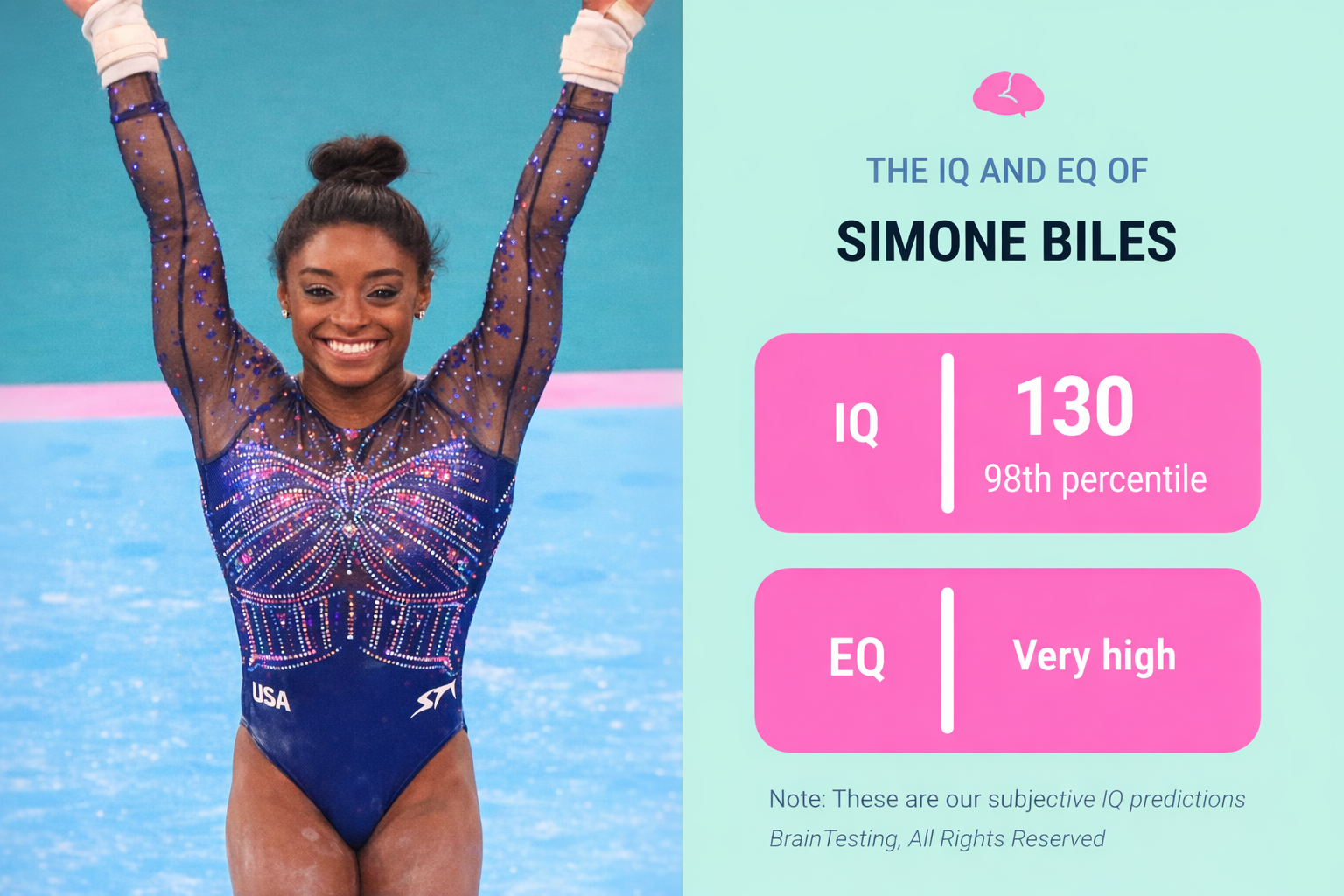
Our prediction by the end: Simone Biles likely falls around 130 IQ, which would place her in roughly the 98th percentile, a Very High range. But that number only makes sense if we earn it, so we should start where her story actually starts: instability, not gold medals.
Before the flips, there was adaptation
Biles was born in Columbus, Ohio, in 1997. Her early life was hard. Multiple biographical accounts report that she and her siblings entered foster care after their biological mother struggled with substance abuse. She was later adopted by her maternal grandparents, Ron and Nellie Biles, who became the stable center of her life.
That matters for an intelligence estimate more than people think. We usually treat IQ as a cold number floating above real life, but development does not happen in a vacuum. A child who moves through chaos and still learns, trusts, adapts, and eventually thrives is showing forms of cognitive and emotional flexibility that are very real. Trauma does not make someone smarter, obviously. But surviving instability and then building elite performance on top of it tells us something important about Biles: she can organize herself under pressure. That same realistic self-management shows up again and again later—especially when the stakes become global.
According to summaries of her autobiography Courage to Soar, Biles repeatedly credits family structure, humility, and steady support rather than some magical idea of effortless talent. I like that detail because it suggests she sees success clearly. She does not talk like someone intoxicated by her own legend. She talks like someone who understands systems—family, coaching, repetition, recovery. That kind of realistic self-assessment is often a sign of solid judgment, not just good PR.
Homeschooling was not an academic escape hatch
If you only glance at Biles’s schooling, you could miss the point. She did not follow the glossy path people often associate with “high intelligence” articles. No Ivy League admissions montage. No viral clip of her solving calculus in the locker room. Instead, as The Sporting News reported in 2024, Biles switched from traditional school to homeschooling and completed the requirements for her high school degree in 2015. That move allowed her to train about 32 hours a week.
Read that again: 32 hours a week training, while still finishing school. That is not evidence of low academic ability. It is evidence of an unusual cognitive workload. Elite gymnastics demands learning complex motor sequences, managing fear, retaining corrections, and adjusting technique through thousands of repetitions. Homeschooling in this context was not a shortcut; it was schedule engineering for mastery.
And that is our first big clue. Highly intelligent people often learn efficiently when motivation is high and the goal is clear. Biles’s life was built around exactly that kind of focused learning. She had to absorb coaching, encode body positions, detect tiny errors, and reproduce corrections under fatigue. School just happened to share space with one of the most demanding apprenticeships on earth.
If you are tempted to say, “Yes, but that is athletic intelligence,” I would answer: correct—and that still counts. Human cognition did not agree to limit itself to SAT-prep categories.
ADHD complicates the picture—in a useful way
Another revealing piece of the puzzle is Biles’s ADHD diagnosis. Mental Floss noted that she was diagnosed with ADHD as a child and later spoke publicly about taking medication with a therapeutic-use exemption. She also pushed back against stigma, writing that taking medication for ADHD is “nothing to be ashamed of.”
This is where lazy IQ stereotypes fall apart. ADHD does not tell us someone’s intelligence level. It tells us that attention regulation works differently. In many people, that difference comes with weaknesses in consistency and organization. But it can also come with high energy, novelty-seeking, rapid shifting, and periods of intense hyperfocus. For an athlete learning extreme skills, that combination can be powerful.
Biles’s career suggests exactly that. She did not merely repeat known routines well; she kept expanding what was possible. That pattern—mastery plus innovation—is a better sign of high ability than simple obedience to a system. She was not the best robot in the gym. She became the gymnast for whom the rulebook had to make room.
The real evidence: her brain seems built for motion
Now we reach the strongest part of the case. If Simone Biles had spent her life in a lab instead of a gym, some researcher would probably be writing papers with words like “sensorimotor integration” and “proprioceptive precision.” Because what she does is not just brave. It is computational.
In a 2021 Q&A with the Houston Chronicle, Biles explained how she can tell whether a vault is good: “From the roundoff, but more from the block… that’s when you can really tell.” That answer is wonderfully casual for something absurdly sophisticated. She is describing real-time analysis of force transfer, angle, momentum, and body position—all without pausing to open a spreadsheet in the sky.
The same interview includes a tiny quote that says a lot. When asked whether she could walk the balance beam and know when she had reached the end without looking, she answered, “Yeah.” Just “Yeah.” Imagine being so physically calibrated that a question sounding impossible to normal humans gets the verbal energy of “pass the salt.”
This is exceptional spatial intelligence. Not average-plus. Not merely “good athlete” intelligence. Exceptional. Biles processes where her body is in space at a level that very few people on earth ever will. And because gymnastics is brutally unforgiving, this ability cannot be fake. You either compute correctly, or gravity submits a complaint.
The innovation evidence is just as strong. Mental Floss highlighted that Biles has multiple gymnastics skills named after her, and the official women’s Code of Points now lists five elements bearing her name. USA Gymnastics also describes her as the most decorated gymnast ever, with 41 World and Olympic medals. That is not only physical talent. It is problem-solving on repeat. To create or master a skill that others considered too dangerous or too difficult, you need spatial imagination, technical planning, body awareness, and the nerve to carry an idea from concept to execution. As we explored in our article on Robin Williams's IQ, the same drive to push beyond established limits is a hallmark of unusually high creative intelligence.
This is also where a standard IQ framework gets awkward. Traditional IQ tests do not fully capture what Biles is best at. They can measure pattern recognition and working memory, sure. But they do a weaker job measuring embodied prediction—knowing where you are in the air, how a twist is unfolding, and how to correct it instantly. So if anything, a general IQ estimate might undersell the total scale of her intelligence—just as we found in our article on Cristiano Ronaldo's IQ, where elite athletic ability points to real cognitive horsepower that standard tests struggle to quantify.
Tokyo showed her intelligence in a different form
Then came the Tokyo Olympics and the twisties. A lot of people treated that episode as if it weakened the case for Biles’s greatness. I think it did the opposite.
According to the Open University analysis of the episode, Biles withdrew from events because she did not want to jeopardize her team’s medal chances or her own health and safety. That is judgment. It is also emotional intelligence under conditions most people will never face. And notice how neatly this connects back to the child we met earlier: the same realism that helped her adapt to instability helped her tell the truth about danger when millions wanted a fantasy.
Stanford neuroscientists explained the twisties as a breakdown in the internal movement models athletes build through endless practice. In plain English: the brain-body map goes unreliable at the exact moment when reliability is non-negotiable. That explanation matters because it shows what elite gymnastics normally requires. Biles usually operates with a refined internal model of movement that lets her perform almost automatically. When that system failed, she noticed it, named it, and acted accordingly.
You might think the intelligent move at the Olympics is always to power through. It is not. The intelligent move is to recognize when your usual strengths have become a danger. Biles did that in public, under massive pressure, while being criticized by people whose most dangerous acrobatic act is sending tweets from the couch.
That decision also fits a broader pattern. In interviews and mental-health reporting, Biles has spoken openly about anxiety and tools for managing it. She does not come across as someone ruled by emotion; she comes across as someone who studies her own mind and works with it. That is metacognition—the ability to think about your own thinking—and it is strongly associated with high-level performance in all kinds of fields.
She did not stop being curious after Rio
If school had only ever been a casualty of training, we might hesitate a bit more on the IQ estimate. But that is not the picture we get. After the 2016 Olympics, Biles began studying business administration online at the University of the People. As VOA News reported in 2018, she chose the program because a full-time traditional college schedule was nearly impossible with her life, and she said she had “always wanted to work in the business industry.”
That sentence is a small but useful clue. Biles was not only thinking about the next meet. She was thinking ahead—toward business, brand, and life after competition. Practical intelligence counts too. In fact, practical intelligence is often what keeps brilliant people from making spectacularly dumb real-world decisions.
And Biles has generally shown good judgment there. She has navigated endorsements, public image, advocacy, and long-term relevance with unusual steadiness. She is also an effective communicator: concise, calm, rarely rambling, and comfortable describing both technical and emotional realities. That does not prove a specific IQ score, but it supports the broader picture of a sharp, self-aware person with strong executive functioning.
So what is Simone Biles’s IQ?
We are not grading a term paper here; we are trying to estimate the general intelligence of someone whose biggest gifts happen to appear on vault, beam, and floor rather than in a blue book exam. For context, Lady Gaga—another unconventional creative who rewrote the rules in her field—lands at 136 in our estimate, just one step above where Biles lands.
Pull the evidence together and a clear range appears. She shows elite learning capacity, exceptional body-space computation, creativity under technical constraints, strong self-regulation, public composure, and unusually good self-knowledge. She also adapted to ADHD, pursued education in a nontraditional format, and made high-stakes decisions with more clarity than many less-pressured public figures ever manage.
That does not force us to say 150. We do not need to turn admiration into fan fiction. But it strongly supports a score well above average.
Our estimate: Simone Biles has an IQ of about 130.
That would place her around the 98th percentile, in the Very High category. In ordinary language, that means she is probably smarter than about 98 out of 100 people on general cognitive ability—and off the charts in some sport-specific forms of intelligence that ordinary IQ tests barely touch.
So is Simone Biles a genius? In the broader human sense, yes, I think she is. Not because she fits one narrow stereotype of brilliance, but because her life keeps showing the same thing from different angles: she learns fast, adapts under pressure, invents new solutions, monitors herself honestly, and performs with a level of spatial precision that borders on science fiction.
And honestly, if you can feel the end of a balance beam without looking, I am already prepared to give your brain the benefit of the doubt.



.png)


