.png)
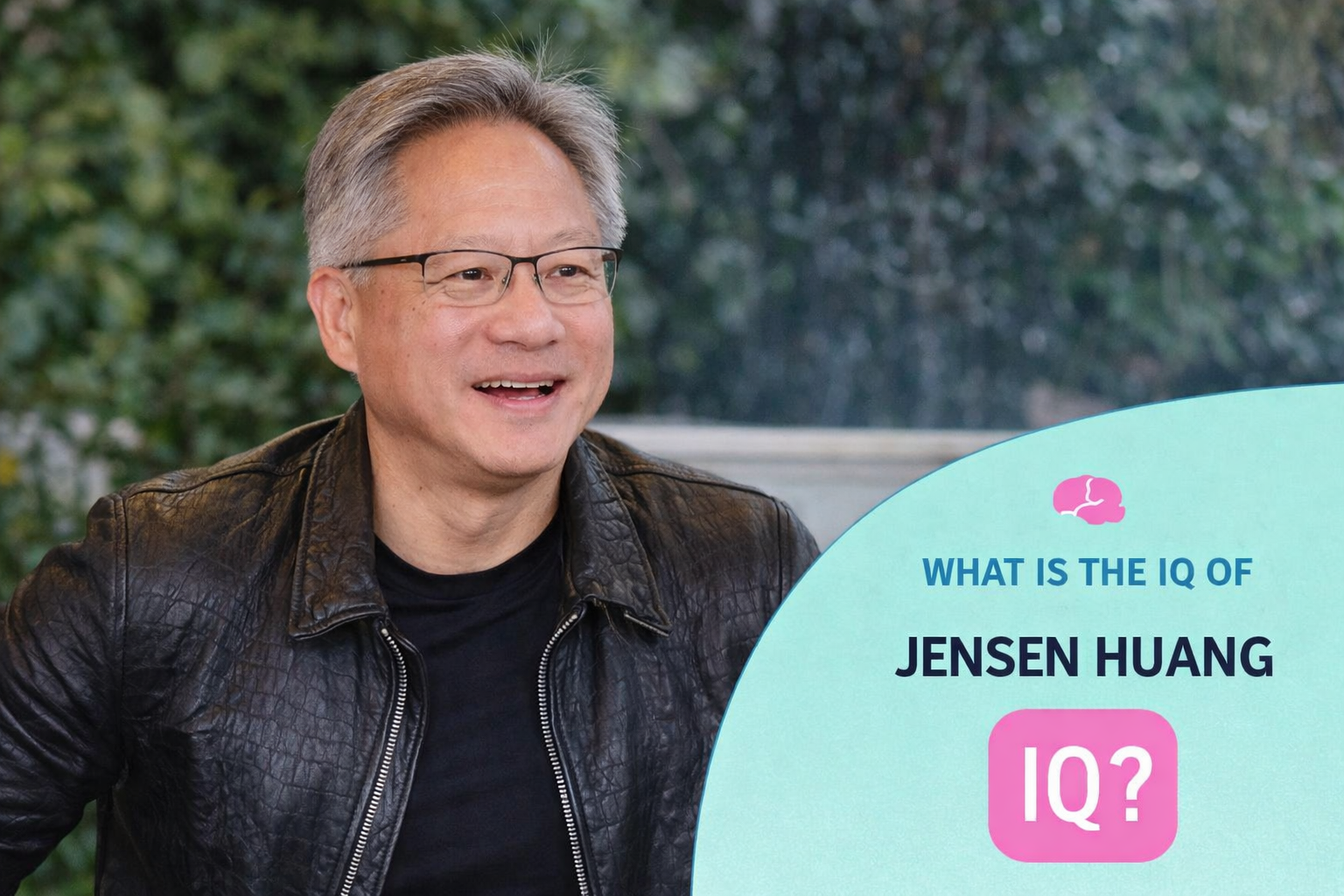


Jensen Huang once cleaned toilets in rural Kentucky and washed dishes at Denny’s. Decades later, he became the leather-jacketed face of the AI revolution. That is not a normal career arc. That is a human plot twist.
So yes, the question is irresistible: how high might Jensen Huang’s IQ actually be?
There is no public record of Huang ever taking an IQ test. No dusty SAT-era rumor, no leaked assessment, no “my score is…” moment on a podcast. What we do have is something more interesting: a long trail of evidence about how he thinks, learns, solves problems, and sees the future a bit earlier than the rest of us. And that, frankly, is better than one number on one afternoon.
By the end of this, we’ll make a numerical prediction. But the number has to earn its way onto the page.
A hard childhood usually reveals something important
According to Encyclopædia Britannica, Huang was born in 1963 in Tainan, Taiwan, to a chemical engineer father and a schoolteacher mother. His family moved to Thailand when he was young, and at age 9 he and his brother were sent to the United States to live with relatives. Then came one of the strangest chapters in any major CEO biography: they ended up at Oneida Baptist Institute in Kentucky, which Huang’s family understood as a boarding school but which functioned more like a harsh reform environment.
Britannica reports that Huang cleaned toilets daily there and endured bullying and even threats. In Ben Thompson’s 2022 interview with Huang for Stratechery, Huang recalled that he and his brother simply treated the labor as normal life: he cleaned bathrooms, his brother worked in tobacco fields. That response matters. It suggests unusual adaptation under pressure. Not IQ by itself, of course, but intelligence is rarely just abstract reasoning floating in a vacuum — a point we made in our piece on what intelligence actually is and how IQ tests measure it. A child who can absorb chaos, normalize hardship, and keep functioning is showing cognitive control very early.
His parents eventually moved the family to suburban Portland, Oregon. There, the story changes tone fast. According to Britannica, Huang attended Aloha High School, excelled academically, and even earned a national ranking in table tennis. The IEEE Engineering and Technology History Wiki adds a lovely little flex: he graduated high school at 16. That is usually not what happens when life has been simple and comfy and everyone leaves you alone. It suggests high processing speed, fast learning, or both.
And remember this pattern, because we’ll see it again: Huang does not merely survive difficult systems. He learns how they work and then starts optimizing inside them. Even as a teenager, that is a big clue.
Engineering school is where the case starts getting serious
If high school gave us hints, college gives us stronger evidence. According to both Britannica and the IEEE history profile, Huang earned a bachelor’s degree in electrical engineering from Oregon State University in 1984 and a master’s in electrical engineering from Stanford in 1992.
Now, electrical engineering is not a polite little major you accidentally stroll through while mostly vibing. It demands mathematical reasoning, spatial thinking, abstraction, and tolerance for complexity. Stanford then raises the bar further (as Stanford tends to do). Getting through that pipeline strongly suggests an intelligence level well above average, especially when the person later uses that training not just to get a job, but to reshape an industry.
This is where I think some readers undershoot Huang. They see the charisma, the keynote stage presence, the black jacket, the Nvidia market cap, and they file him under “great business guy.” Sure—but before any of that, he was a serious engineer. The business success does not replace the technical evidence. It stacks on top of it.
And the stacking matters. One strong credential can be luck, timing, or obsession. Multiple difficult achievements across different environments usually point to deeper cognitive horsepower.
The dishwasher story is funny, but it also screams systems thinking
At 15, Huang began working at Denny’s as a dishwasher. That could be just a colorful “humble beginnings” detail, except Huang keeps describing the job in a way that sounds suspiciously like a future chip architect explaining throughput.
According to Sydney Lake’s 2024 Yahoo Finance profile, Huang said he was Denny’s “best dishwasher” because he planned his work, stayed organized, and “washed the living daylights out of those dishes.” He added, “I never left the station empty-handed. I was very efficient.” I mean… come on. That is not how most teenagers talk about dishwashing. That is a process engineer trapped in an apron.
Those details matter because they show something IQ tests often only partly capture: spontaneous optimization. Some people work hard. Huang seems wired to reduce waste, structure flow, and improve systems almost automatically. You can draw a straight line from that dish pit mindset to the later Jensen Huang who asks why something should take 74 days if first-principles thinking says 6 might be possible.
And then there is the most Denny’s sentence in modern business history: Nvidia was conceived in one. Britannica and Yahoo Finance both recount that Huang co-founded Nvidia in 1993 with Chris Malachowsky and Curtis Priem after the idea took shape over breakfast at a Denny’s booth. Somewhere, a pancake is still feeling smug.
Founding a semiconductor company at 30 is not just ambitious. It is cognitively audacious. You need technical knowledge, risk modeling, market intuition, and the nerve to act before certainty arrives. Most people want the map first. Huang seems comfortable drawing while moving.
Nvidia is the strongest evidence in the entire case
Plenty of smart people earn engineering degrees. Fewer build enduring companies. Fewer still build a company that gets the future right more than once.
According to the IEEE Engineering and Technology History Wiki, Nvidia developed the GPU in 1999 as a programmable logic chip and later helped turn GPUs into the standard architecture not only for graphics but for scientific computing and deep learning. The same profile notes that Huang recognized early that GPUs were well suited for deep neural networks because they could accelerate training by orders of magnitude. That is exactly the kind of pattern recognition we look for when estimating exceptional intelligence.
This is where Huang separates himself from the merely brilliant engineer. He did not just understand chips. He understood what chips would become useful for. That leap—from technical object to future ecosystem—is much rarer.
Britannica goes further, crediting Huang’s insight into GPUs and machine learning with helping bring machine learning into the mainstream. And at Nvidia’s 2018 GPU Technology Conference, as Britannica notes, Huang described GPU progress outpacing Moore’s Law so dramatically that the trend was nicknamed “Huang’s Law.” You do not get an informal law named after you in computing by being sort of sharp on Thursdays.
Notice the pattern building now. Early adaptation. Fast academic progress. Elite technical training. Systems thinking in ordinary jobs. Then long-range technological foresight on a global scale. If we are building an IQ estimate like a case file, this is the point where the folder gets thick — a profile our piece on whether intelligence actually predicts career success explores in depth.
How Huang thinks may be even more revealing than what he built
In his 2022 interview with Ben Thompson, Huang offered a concise definition of intelligence: “the ability to recognize patterns, recognize relationships, reason about it, and make a prediction or plan an action.” That sounds suspiciously like a description of the mind we estimated when we looked at Demis Hassabis — another technologist whose IQ shows up as foresight more than test scores. That answer is revealing for two reasons. First, it is actually a pretty good lay summary of cognitive intelligence. Second, it is almost a description of his own career.
The Lex Fridman podcast transcript gives us an even clearer view into Huang’s mental style. There, he explains a principle he calls “the speed of light,” his shorthand for asking what physics fundamentally allows before compromise and habit creep in. He says every variable gets compared against that limit: memory speed, math speed, power, cost, time, effort. That is first-principles reasoning in its purest form.
Fridman also gets Huang to explain one of his favorite management moves: if someone says a project takes 74 days, Huang asks what would be possible if it were built from scratch. Sometimes, he says, the answer is 6 days. The point is not that the 68 extra days are always stupidity. The point is that many constraints are inherited, not fundamental. Very high-IQ people often show exactly this habit: they mentally strip away assumptions faster than other people can even notice them.
Another revealing quote from the Fridman interview: Huang says systems should be “as complex as necessary, but as simple as possible.” That sounds elegant because it is elegant. But elegance in engineering usually reflects deep understanding, not superficial cleverness. Anyone can add complexity. The real trick is knowing what can be removed without breaking the machine. That is advanced reasoning.
He also repeatedly downplays innate genius. In the Fortune profile by Eleanor Pringle, Huang says, “There’s no magic; it’s just 61 years of hard work every single day.” In a 2025 60 Minutes interview, he repeats nearly the same thought, describing it as extraordinary that “a normal dishwasher-busboy could grow up to be this.” I believe he means it. I also think he is being modest. Hard work matters enormously; hard work plus rare pattern recognition matters more. We do not need to choose one.
His 2023 comments to Fortune add another layer. Speaking at Computex in Taipei, Huang argued that AI had effectively made “everyone a programmer now—you just have to say something to the computer.” That remark is not just tech evangelism. It shows he understands intelligence dynamically: once a skill becomes automated, the truly valuable thinking moves elsewhere.
His intelligence is not just technical
You might be tempted to think Huang is one of those brilliant-but-narrow people who can optimize a supercomputer and then accidentally insult an entire room before appetizers. The reporting suggests otherwise.
In Fortune, employees describe him as demanding and perfectionistic, and Huang openly agrees with the label. “If you want to do extraordinary things, it shouldn’t be easy,” he says. That may not make him everyone’s dream relaxed manager, but it does point to strong executive functioning and unusually high standards.
Meanwhile, Stratechery captures something softer and more important: Huang says his greatest gift is surrounding himself with amazing people and giving them the chance to do amazing work. He credits co-founders and top engineers repeatedly. That is a sign of social intelligence. Remember the pattern from childhood and Denny’s: he reads systems fast, and people are systems too—messier ones, admittedly.
Even his humility contains information. In the 60 Minutes interview, Huang admits that despite his polished public image, he still gets scared walking onto a huge keynote stage because he is “an engineer, not a performer.” That line rings true. It also suggests self-awareness rather than vanity. Again, IQ is not EQ, but in real life they often reinforce each other.
And then there is his broader philosophy of intelligence. Across interviews, Huang keeps coming back to judgment, resilience, and the ability to “see around corners.” That is not a man worshipping test scores. That is a man who has spent a lifetime discovering what raw horsepower can and cannot do.
Final prediction: Jensen Huang’s estimated IQ
So where does all of this leave us?
We have no official IQ score. But based on Huang’s accelerated education, electrical engineering training, Stanford master’s degree, extreme systems thinking, first-principles reasoning, long-range forecasting in computing, and decades of execution at the very top of a brutally difficult industry, we can make a serious estimate.
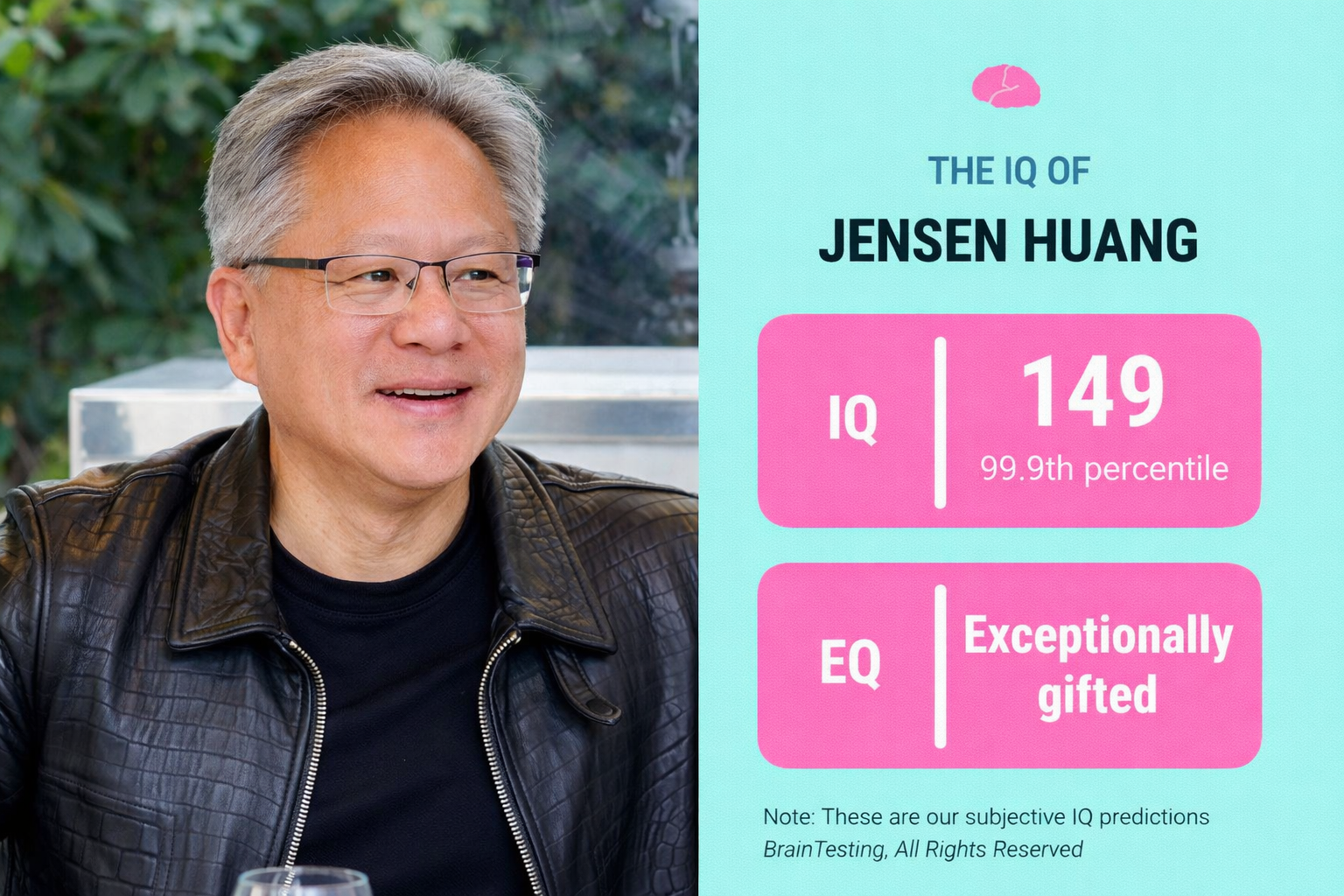
Our prediction is that Jensen Huang’s IQ is around 149.
That would place him roughly in the 99.9th percentile, in the Exceptionally gifted range.
Why not lower? Because too many independent lines of evidence point upward: technical depth, unusual abstraction ability, strong verbal reasoning, strategic foresight, and the rare capacity to simplify extreme complexity. Why not absurdly higher—160 or 170? Because his brilliance seems less like the isolated lightning bolt of a pure theoretical prodigy and more like a powerhouse combination of very high general intelligence, elite engineering reasoning, resilience, and execution.
And one more thing: IQ, even when estimated carefully, probably undersells Huang’s best traits. Standard scores do not fully capture foresight, leadership under uncertainty, or the ability to build a company that keeps being early to the next big thing. In other words: not just a genius in a lab, but a genius who ships.
That may be the most Jensen Huang outcome possible. Not a sterile number detached from life, but a mind you can actually watch operating—from the dish pit to the data center.



.png)