.png)
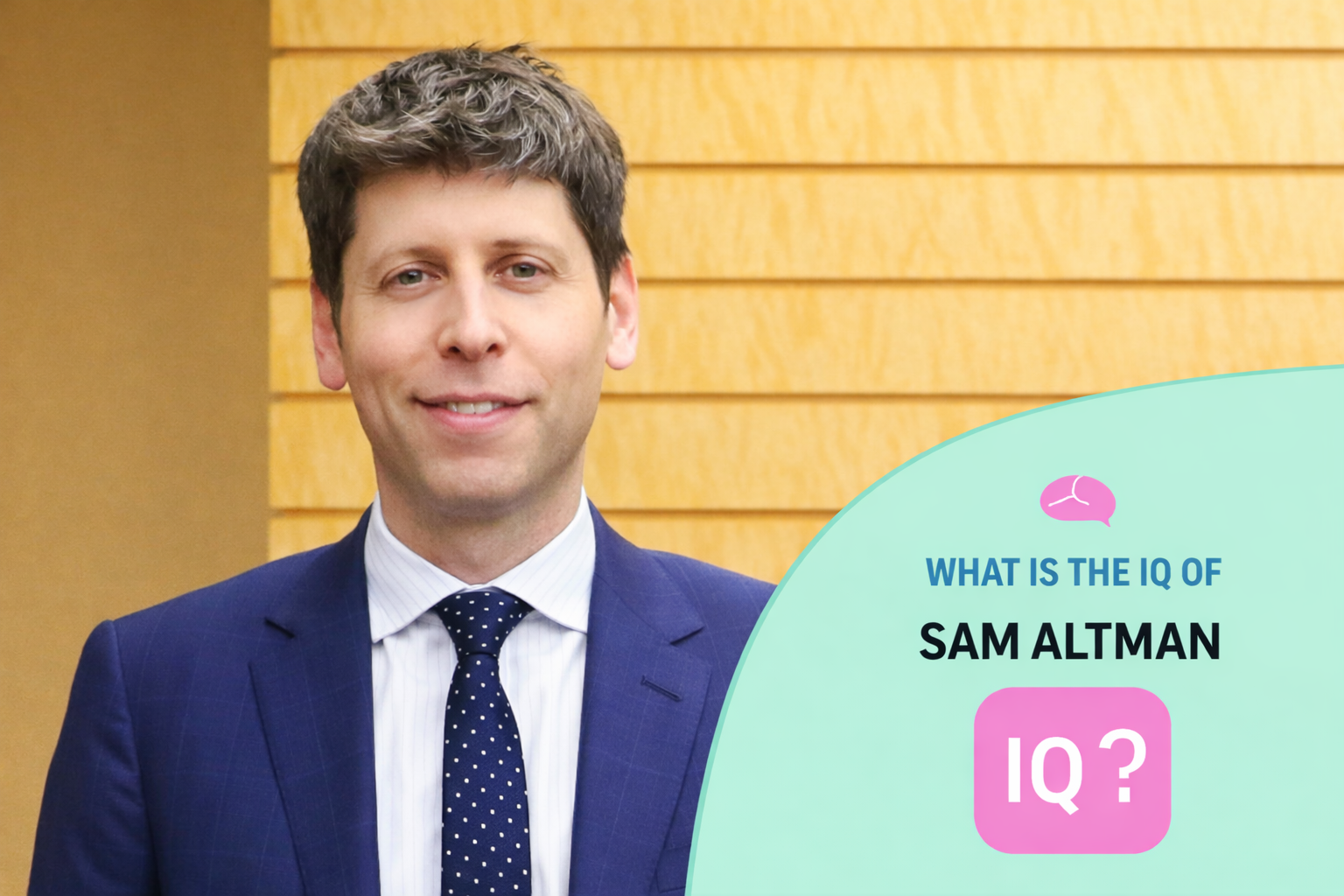


Sam Altman is one of those people who make the word “smart” feel a little flimsy. He helped turn OpenAI into the company behind ChatGPT, became the most scrutinized executive in AI, got pushed out, came back, and somehow ended up even more central to the story. That is not ordinary career turbulence. That is what happens when someone keeps operating three or four moves ahead of everyone else—or at least tries to.
So, naturally, people want a number. What is Sam Altman’s IQ?
Annoyingly, there is no credible public record of one. No leaked test. No old interview. No “my IQ is X” brag slipped into a podcast clip at 1:17 a.m. So we have to do this the honest way: build a case from the evidence of his life. The schools he entered, the bets he made, the people who trusted him, the scale of the problems he gravitates toward, and the places where that same brain seems to have unsettled people.
That last part matters. If we are going to estimate Altman’s intelligence, we should not do Silicon Valley fan fiction. We should do psychology.
The early clues: technical curiosity, confidence, and a kid who did not seem scared of complexity
According to TIME’s 2023 profile, Altman grew up Jewish in St. Louis and was “playing on an original Bondi Blue iMac” as a kid. That detail is small, but not trivial. Early attraction to computers does not equal genius—plenty of bright kids just liked clicking around—but when that fascination sticks and turns into fluency, it often signals a mind that enjoys structured complexity. Some children see a machine. Others see a world to decode.
The same TIME profile described him in high school as “equal parts nerdy and self-assured.” That is a revealing combination. The “nerdy” part points to deep interest; the “self-assured” part hints that he was not simply bookish but unusually comfortable trusting his own judgment. As TIME also notes, Altman came out as gay as a teenager. That does not raise or lower an IQ estimate by itself, obviously. But it does tell us something about his independence. High achievers who later make giant, unpopular bets often show that streak early: they are willing to be out of step if they think they are right.
So the first pattern is already there. Technical curiosity. Confidence. Low fear of complexity. Not proof, but a very decent opening hand.
Stanford mattered. Leaving Stanford mattered more.
According to TIME, Altman enrolled at Stanford in 2003 to study computer science. That is already one useful signal. Stanford is not handing out seats in CS because someone has a nice smile and a decent attendance record. Selection at that level strongly overlaps with the kinds of traits IQ tests capture reasonably well: abstract reasoning, quantitative ability, fast learning, and sustained academic performance.
Still, Stanford is not the best clue. What he did with Stanford is the better clue.
As TIME reported, Altman left after two years to start Loopt, a location-based social networking app. The same profile notes that he credited college poker games with teaching him lessons about psychology and risk. I love that detail because it sounds exactly like the mind we later see at OpenAI: not just technical, but probabilistic. Not just “how does this system work?” but “how do people behave under uncertainty?” That is a very high-level cognitive habit. He was not simply learning facts; he was collecting decision frameworks.
And the dropout move? Silicon Valley has turned dropping out into such a cliché that it almost needs a warning label. But in Altman’s case, it reads less like performance and more like calculation. He does not look like someone rejecting learning. He looks like someone deciding that the faster classroom had moved outside. That is not always wise—lots of people make that bet and vanish into a cloud of LinkedIn optimism—but it does suggest strong independent judgment and high tolerance for uncertainty.
Loopt is useful precisely because it was not magic
Loopt joined the first Y Combinator batch and was sold in 2012 for $43 million, with Altman netting roughly $5 million, according to TIME. That is a real success, but not one of those absurd unicorn stories people repeat at dinner parties until everyone wants to fake their own startup. And that is helpful. It lets us see Altman without the distortion field of total victory.
In that same TIME profile, he described the lesson this way: “The way to get things done is to just be really f-cking persistent.” That quote is one of the most valuable pieces of evidence in the whole puzzle. Why? Because it stops us from making a classic mistake about intelligence. Very bright people are often imagined as effortless. Altman’s own explanation is the opposite. His advantage seems to come from the combination of high reasoning ability and unusually stubborn follow-through. That is a nasty combo in competitive environments, and the kind of pairing we explored in our piece on whether intelligence actually predicts career success.
So Loopt tells us something important. He was smart enough to build and sell a serious company in an emerging area, but also grounded enough to talk about persistence instead of pretending the universe simply recognized his brilliance on sight. Good sign. Slightly irritating if you were competing with him, but good sign.
At Y Combinator, his intelligence starts looking less academic and more predatory—in the nice sense
If Loopt showed entrepreneurial intelligence, Y Combinator showed pattern recognition on a much larger canvas. According to TIME, Paul Graham saw in Altman a “rare blend of strategic talent, ambition, and tenacity.” Graham even joked that you could parachute him onto “an island full of cannibals” and he would end up king. That is a ridiculous image, which is probably why it sticks. It also tells us how elite peers saw him: adaptive, quick, hard to corner. It is a profile that our look at Steve Jobs’s IQ traces in a very similar shape.
That kind of praise matters because Graham was not evaluating a test taker. He was evaluating a decision-maker. A person who could read markets, founders, incentives, and timing all at once. Those are real-world intelligence demands, and they draw on more than classic IQ. They pull in social intelligence, judgment under pressure, and the ability to notice hidden signal in messy human situations.
According to Y Combinator’s official history, Altman went on to become president of the accelerator. That role is underrated as intelligence evidence. Running YC means studying hundreds of founders and ideas and figuring out which ones have real traction, which ones are delusional, and which ones are delusional in the useful way that occasionally changes history. You are not solving one neat puzzle. You are building a mental model of how innovation itself behaves. That calls for conceptual range, fast updating, and a very strong nose for talent.
Remember the poker detail from Stanford? This is the grown-up version of it. The same mind that liked psychology and risk now had a front-row seat to thousands of high-stakes human bets.
OpenAI is where the estimate really climbs
Now we get to the strongest evidence.
OpenAI did not make Altman smart, of course. But it revealed what kind of smart he probably is. The Associated Press reported in 2024 that Altman, in his Giving Pledge letter, emphasized the “hard work, brilliance, generosity, and dedication” of the many people whose efforts made his success possible. That is worth noting because it pushes against the lone-genius myth. He does not publicly frame himself as a wizard descending from the mountain with GPUs and prophecy. Good. Silicon Valley already has enough of those.
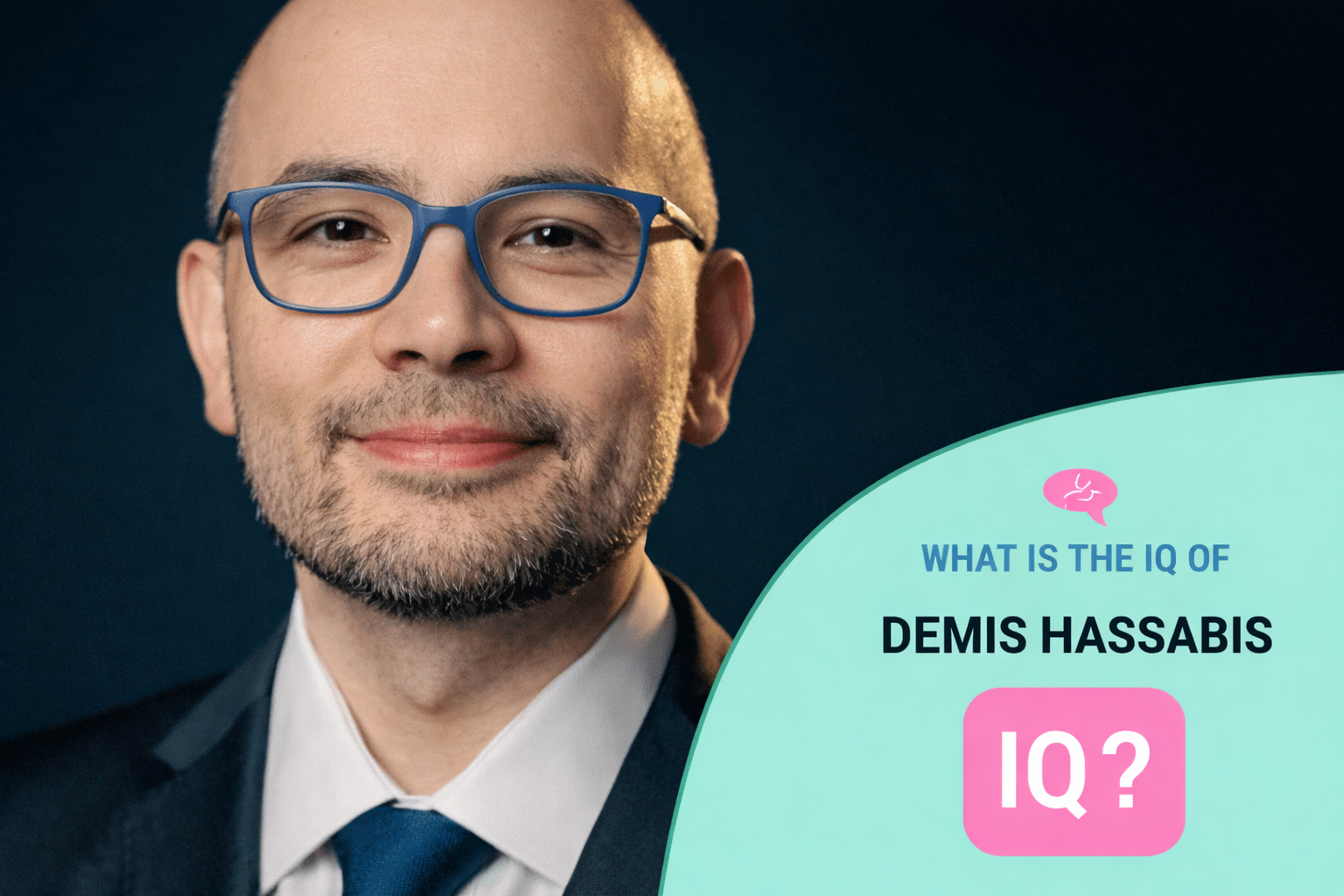
At the same time, leadership at OpenAI is extremely strong evidence of unusual cognitive power. OpenAI’s official materials describe a mission centered on ensuring AGI benefits humanity. Grand phrasing? Definitely. But even allowing for corporate idealism, the role requires operating across research, product, policy, capital, media, regulation, and geopolitics at once. Most people are tired just reading that sentence. For another window into the kind of mind that ends up running modern AI labs, see our research-based estimate of Demis Hassabis’s IQ.
TIME’s 2023 profile described OpenAI as the “public face and leading prophet of a technological revolution,” with Altman at the center. Magazine language aside, the point stands: his job required multi-variable reasoning on a scale that very few executives ever face. People with very high IQs often show one outward trait that everyone around them notices sooner or later—they can juggle more layers of abstraction without losing the plot. Altman’s career strongly suggests that kind of mental bandwidth.
And then there is the ambition itself. In its 2024 follow-up, TIME reported that Altman had discussed raising up to $7 trillion to build AI chip capacity. Seven trillion. Once you are casually using numbers that sound like they were generated by an overheated central bank, we are no longer talking about ordinary founder cognition. We are talking about a person who feels comfortable mentally simulating industry-scale transformation.
This is where I would place him clearly above the merely elite-professional range. He seems able to reason across technical, financial, and political systems without shrinking the problem down to something emotionally manageable. Many smart people need smaller boxes. Altman appears to reach for bigger ones.
But brilliance and judgment are cousins, not twins
This is where hero worship needs a glass of cold water.
In its 2024 profile, TIME reported criticism from insiders who believed safety at OpenAI had “taken a backseat to shiny products.” That line is important because it reminds us that cognitive horsepower does not automatically produce careful judgment. A person can be dazzlingly good at modeling the future and still be too eager to arrive there first.
A 2024 Tom’s Guide summary, drawing on a deeper reported investigation, said one internal memo opened with the blunt word “Lying.” Even treating that secondhand material with caution, it still serves as a useful brake on over-romanticizing him. The most defensible reading of Altman is not “flawless genius.” It is “extremely high-powered strategist with possible blind spots in restraint and transparency.”
And for an IQ estimate, that distinction matters. IQ is about cognitive ability, not sainthood. Not prudence. Not moral cleanliness. History is full of brilliant people who were also, to use a technical term, a lot.
How Altman talks about intelligence gives away the shape of his own
One of the clearest final clues comes from how he discusses AI itself. In a 2025 interview summarized by TechRadar, Altman said of his child, “I don’t think he’ll be smarter than AI.” You may find that provocative, gloomy, realistic, or faintly dystopian before coffee. But psychologically, it is revealing. Altman does not seem obsessed with his own status inside the intelligence hierarchy. He thinks comparatively, structurally, almost architecturally: what kinds of intelligence exist, where are their limits, and how do they relate?
The same summary noted that he still believed current models lacked essential parts of human-level cognition. So this is not just chest-thumping about machines winning. It is categorization. Distinction-making. Mapping different forms of intelligence against each other. That kind of abstraction is not everything, but it is very consistent with someone far out on the right tail of analytical ability.
And remember that self-assured teenager from St. Louis, plus the poker-playing Stanford student who liked psychology and risk? You can still see both of them here. Only now the table is global and the chips are, well, civilization-sized.
Final estimate: Sam Altman’s IQ is likely around 146
Put the evidence together and the picture is pretty clear. We have early technical fluency, admission to Stanford for computer science, a calculated leap into Loopt, years of reading risk and incentives, selection by Paul Graham to run Y Combinator, and then leadership at OpenAI during the defining AI breakout of the decade. The same traits show up over and over: fast abstraction, strategic range, comfort with uncertainty, and unusual confidence in high-stakes environments.
We also have a reason not to overshoot. Critics and internal tensions suggest that however brilliant Altman may be, his judgment is not above question. That keeps him out of the mythic, sainted super-genius category people online like to create whenever a founder speaks in complete sentences.
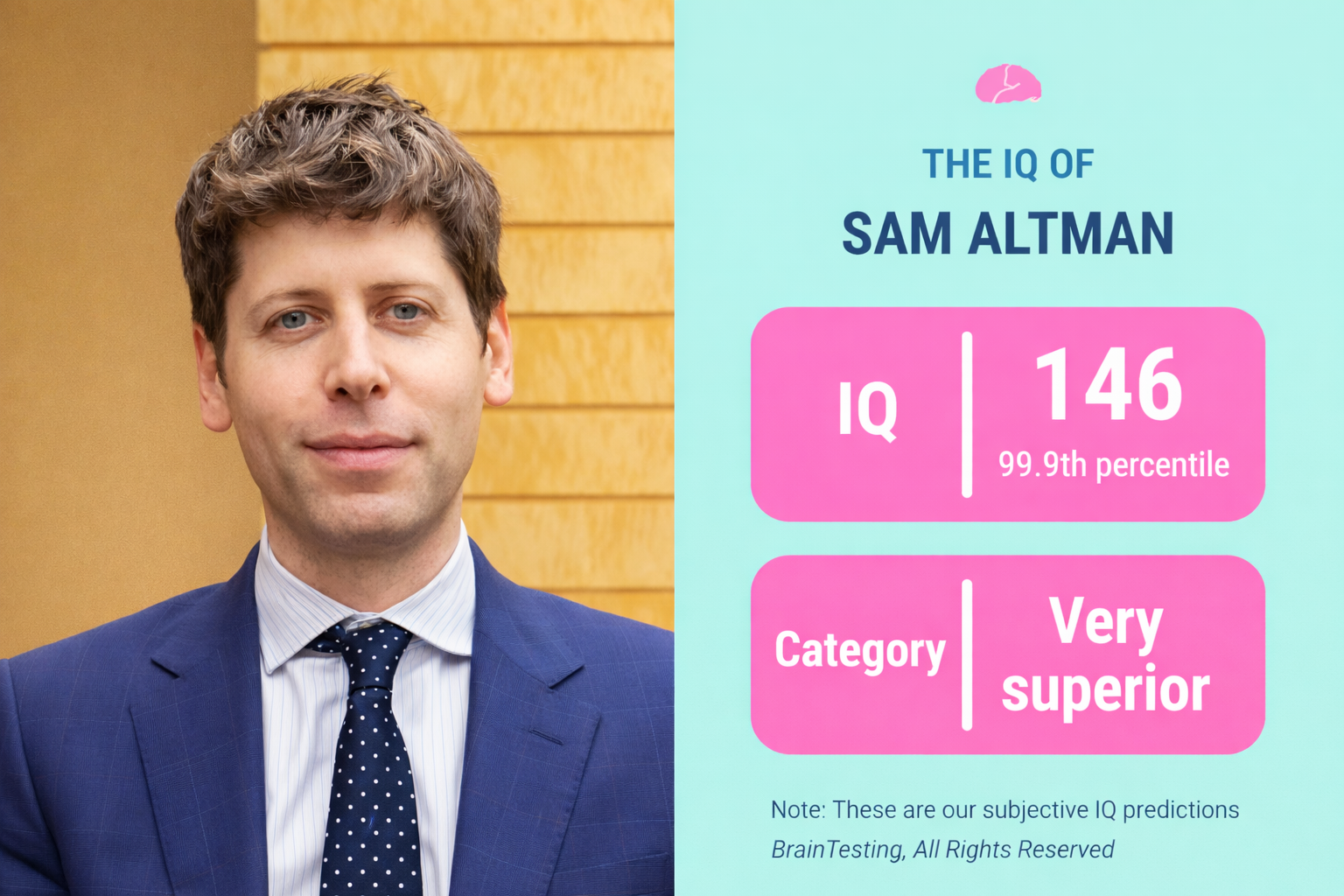
Our estimate is that Sam Altman’s IQ is 146. That places him around the 99.9th percentile, in the exceptionally gifted range.
Why 146 and not 135? Because 135 is “clearly brilliant by ordinary standards.” Altman’s life looks stronger than that. Why not 160? Because the public evidence points less to once-in-a-generation theoretical genius and more to extraordinary strategic synthesis—someone who sees the whole board, reads the players, and is willing to bet before the rest of the room has finished naming the game.
Honestly, that may be the scarier kind of intelligence anyway.



.png)


.png)